Have you heard the word Arribada?
Thousands of Sea Turtles on a Single Beach
The Arribada is the mass-nesting phenomenon of Olive Ridley turtles coming ashore together to lay their eggs. The word means "arrival" in Spanish — in a single nesting event, thousands to tens of thousands of turtles converge on the same beach. It's only seen along certain Pacific coasts in Mexico, Costa Rica, and Panama, making it a globally rare sight.
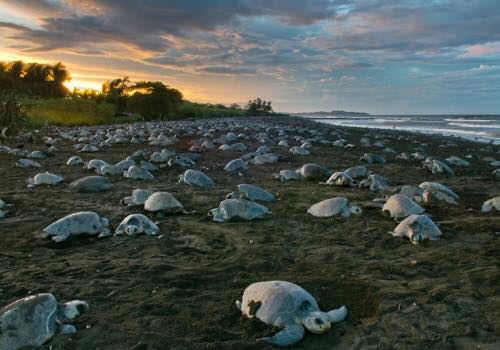
"The Arribada has started"
September 2015, less than a month before my return to Japan. I got the news that an Arribada was happening. There was no way I was leaving Costa Rica without seeing one. I made the call to go right then.
The problem was the distance. From my post in San Vito to the beach, it was over 14 hours by bus. I went anyway.

The Arribada Was Already Over
The next morning, I went to the beach.
A vast stretch of black sand, perfectly clear sky. And — not a single turtle.
The sand was scattered with countless eggshells. The Arribada had happened about a week before I arrived, and the turtles, finished with their nesting, had long since returned to the sea.


I Ate a Sea Turtle Egg
Since I'd come all this way, I tried a sea turtle egg. The local way: pour tomato juice into a shot glass, drop in one turtle egg.
The white was loose and didn't set. The yolk had a springy texture I wasn't going to chew on, so I swallowed it whole.

Harvest and sale of sea turtle eggs is illegal in Costa Rica, but at the time some Pacific coast communities still harvested as a local custom. Today, protections are stricter.
14 hours by bus and it was already over. I don't regret it. The vast stretch of black sand, the dog that came along, the turtle egg I swallowed whole — I still remember it all clearly.
The farthest trip I made in Costa Rica.
Travel Guide (general information)
※ This section combines public information with the author's notes; please confirm the latest reserve rules, fees, and operating hours on the official sites.
What is an arribada?
- Meaning: Spanish for "arrival." A phenomenon in which Olive Ridley sea turtles (Lepidochelys olivacea) come ashore on the same beach in groups of hundreds to thousands to lay eggs.
- Main nesting sites: In Costa Rica, Ostional and Nancite; elsewhere only a handful of beaches such as Odisha (India) and Escobilla (Mexico).
- Timing: During the rainy season (roughly July–December), most often within 3–10 days around the new moon to the last quarter.
- Mechanism: Synchronized mass nesting raises hatchling survival through "predator dilution" — an evolutionary strategy.
Ostional National Wildlife Refuge
- Location: Black-sand Pacific coast in Guanacaste; about 1–1.5 hours by car from Santa Cruz.
- Viewing rules: Authorized guide required, no white lights at night (red filters only), keep at least 3 m from turtles, do not touch eggs.
- Sustainable-use program: Costa Rica runs an unusual model that allows local residents limited egg harvest within the first 36 hours (collecting only eggs that would otherwise be crushed by later nesters).
Things to know before going
- Predicting an arribada is imperfect — moon phase and updates from local volunteers are the main clues.
- As in this article, you may arrive only to find it has already finished. Build flexibility into your dates.
- Most observation happens at night: bring insect repellent, long sleeves and pants, and a red-filter flashlight.
- It's a long trip from San José; allow several days for safety.