In October 2013, I landed in Costa Rica, a small country in Central America. Within a land area roughly the size of Japan's Kyushu and Shikoku combined (51,100 km²), about 5% of the world's biodiversity lives. For the next two years, I would be working near an Indigenous village in the south of the country.
5% of the World's Biodiversity in an Area the Size of Kyushu + Shikoku
More than a quarter of the country's land is designated as national parks or protected areas, making it a treasure trove of endemic species — quetzals (often called the "phantom bird"), sea turtles, poison dart frogs, and many more. Costa Rica is recognized worldwide as a leader in ecotourism.
The current population is around 5.1 million (it was about 4.7 million in the mid-2010s when I lived there). Most of the population is concentrated in the metropolitan area around the capital, San José. The population is largely composed of people of European and mestizo descent, with Afro-Caribbean communities along the Caribbean coast and Indigenous communities scattered across the country.
A mountain range runs through the center of the country, creating sharply different climates and vegetation between the Pacific and Caribbean sides. San José, sitting above 1,000 m in elevation, is comfortable year-round, while the coastal areas have a tropical climate. One distinctive feature of Costa Rica is its clearly divided seasons — the dry season (December to April) and the rainy season (May to November). During the rainy season, a brief downpour comes through almost every day at roughly the same hour.
The Days I Was Called "Chino"
Walking through the streets, I was often called out to with "Chino!" (literally "Chinese," but used as a general term for anyone of East Asian appearance). This habit of addressing East Asian–looking people that way is common across Spanish-speaking Central America. Even though Japanese anime and pop culture are well-liked locally, distinguishing between East Asian countries isn't really part of everyday life.
What's interesting is that you can usually tell from the tone whether someone means it kindly or not. When I was called "chinito" (with the suffix -ito / -ita, the Spanish diminutive that conveys smallness, cuteness, or affection), there usually wasn't any discriminatory intent behind it. It carried the same warm, casual ring people use with kids or close acquaintances, and over time I grew used to that sense of closeness.
Once they realized I was Japanese, the people who'd called me "chinito" usually stopped using the word. It felt as though the initial "East Asian–looking person" label was replaced, in their minds, by a specific individual.
What I Saw in an Indigenous Village — Teen Pregnancies and Malnutrition
From November 2013 to September 2015, I was based in San Vito in southern Costa Rica. The clinic where I worked was located near an Indigenous village called La Casona. The two main challenges I encountered there were teenage pregnancies and malnutrition. Even in a country like Costa Rica, with its well-developed healthcare system, rural communities had a very different face.
Behind the Name "Rich Coast"
In 1522, Spanish soldiers landed on the Pacific coast of what is now Costa Rica. What they saw was Indigenous people wearing shining gold ornaments, and that sight gave the country its name: "Costa Rica," meaning "rich coast." Cartago was founded in 1564, but disease drastically reduced the Indigenous population. With few mineral resources, large plantation owners never came to dominate, and instead a society centered on small white landowner-farmers took shape. This laid the groundwork for the country's later image as a stable democracy.
By 1890, coffee exports made up 80% of all the country's exports. Black laborers from the Caribbean settled here as part of that workforce, but they were subject to a movement-restriction law that remained in place until 1947. Hidden behind Costa Rica's "richness" is this kind of racial-discrimination history.
Then in 1948, Costa Rica abolished its standing army. After a brief civil war, a new constitution was drafted, and the budget that had funded the military was redirected to education and healthcare. The country's high literacy rate and its near-universal-access public healthcare system are direct extensions of that decision. The foundation for Costa Rica's reputation as "the model country of Central America" rests right here.
Once you know the country's history, the streets start to look different. The old stone buildings of Cartago, the faces of people working at the markets in San José, the distinct food culture along the Caribbean coast — every one of these things sits on top of that layered history.
"Pura Vida" — Costa Ricans use this phrase in every kind of situation. As a greeting, as a thank-you, as a way of saying "everything's great." At first I had no idea what it meant, but after living there long enough, the feeling slowly soaked into me.
Truly "knowing" this country probably takes more than two years. Still, in this series I want to record what I saw, who I met, and what I ate while I lived there — as faithfully to the original feel as I can. Next time, I'll head to Volcán Irazú, on the day I went to see its crater lake.
Travel Guide (general info)
※ This section combines public information with the author's notes; please confirm the latest fares, hours, and travel advisories on the official sites.
Basic facts
- Area: about 51,100 km² (roughly the size of Japan's Kyushu + Shikoku combined) / Population: about 5.1 million
- Capital: San José (elevation about 1,170 m) / Official language: Spanish
- Currency: Costa Rican colón (CRC). US dollars are also widely accepted in tourist areas
- No standing army: abolished by the 1948 constitution and reallocated to education and healthcare
Climate and best season
- Dry season (Dec–Apr): peak tourist season, mostly clear skies, slightly higher prices
- Rainy season (May–Nov): lush green, fewer crowds, strong afternoon showers; September–October are the wettest months — watch road conditions
- Elevation range: from tropical coasts to the Central Valley (around 20°C year-round) up to cool mountain areas
Entry and health
- Visa: Japanese passport holders do not need a visa for tourist stays of up to 90 days (requirements may change — check with your foreign ministry before departure)
- Vaccinations: yellow fever vaccination is generally not required, but may be required if arriving from certain neighboring countries
- Water: tap water is reportedly drinkable in urban areas, but bottled water is recommended for travelers
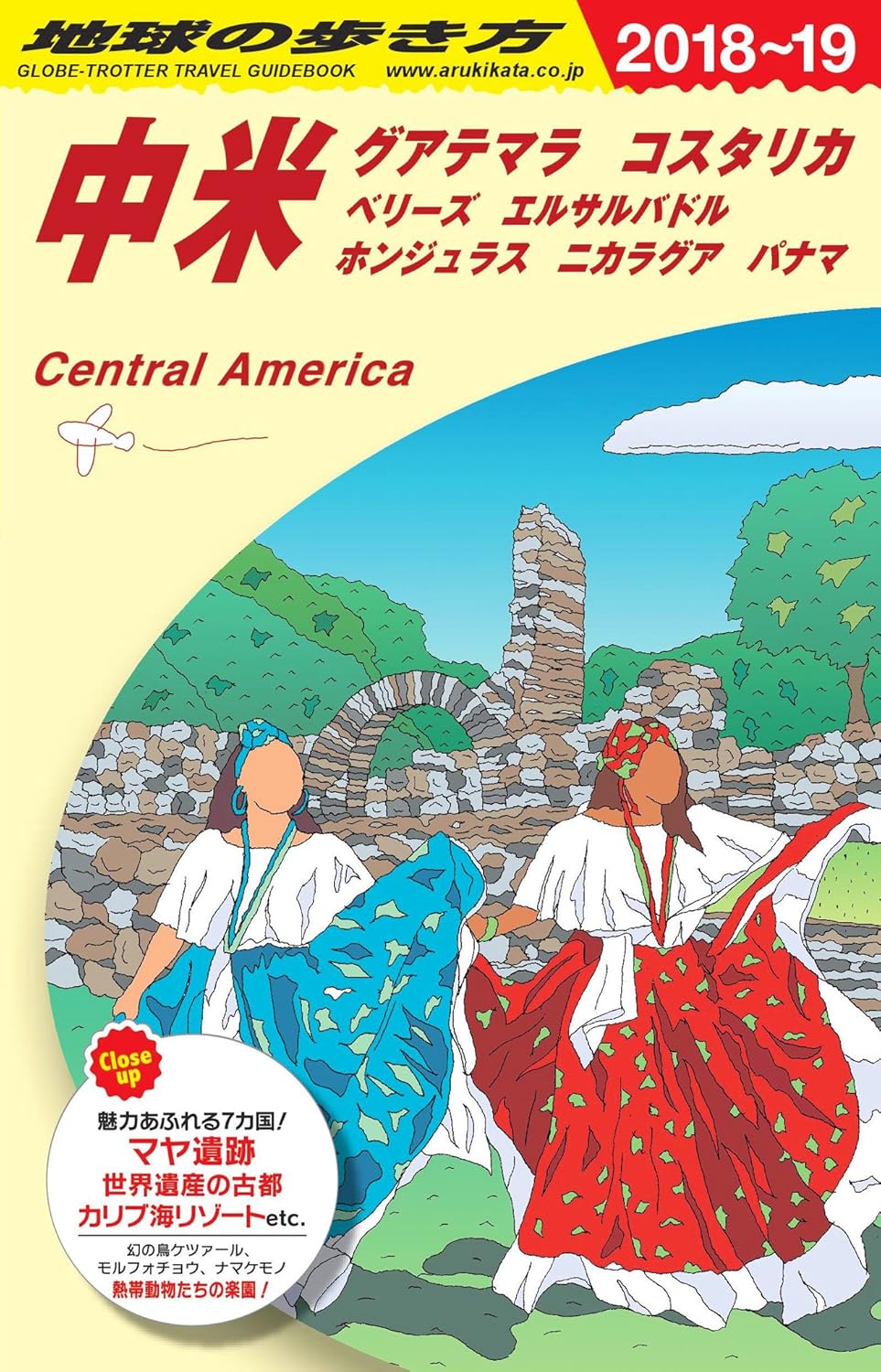
Handy to have one book before you go — there are plenty of English guidebooks for Costa Rica, but if you want a single Japanese-language volume, the classic is the Globe-Trotter Central America edition. It's also handy for planning a loop through Costa Rica, Panama, Nicaragua, Guatemala, and beyond.
![Globe-Trotter Central America [Costa Rica chapter] (Kindle edition)](../../images/amazon/B07645MQQN.jpg)