This article is the technical companion to Costa Rica Stories #8 "Building a Brace by Hand in Costa Rica". It documents the parts list, cost breakdown, and functional outcomes of the simple short-leg brace I built. For the patient story and clinical reflection, see #7.
Design intent: get short-leg brace function from locally available parts
February 2014, San Vito clinic. A patient came in three months post-stroke. BRS Ⅱ-Ⅰ-Ⅲ, severely impaired sensation, ambulation with moderate assistance. In Japan, with a properly fitted short-leg brace and a cane, indoor independent walking would have been a realistic goal. But in Costa Rica's public system, the official brace would arrive about eight months after the application — and a patient cannot wait that long without functional training. The starting point of the design was a "bridge brace" for that eight-month gap.
The reference design was the simple short-leg brace concept by Iwata Haruyuki — in Japan, around 2,000 yen of hardware-store parts. Translating that into materials available in a Costa Rican town turned out to be the actual challenge.
Parts list (total: about 8,000 yen)
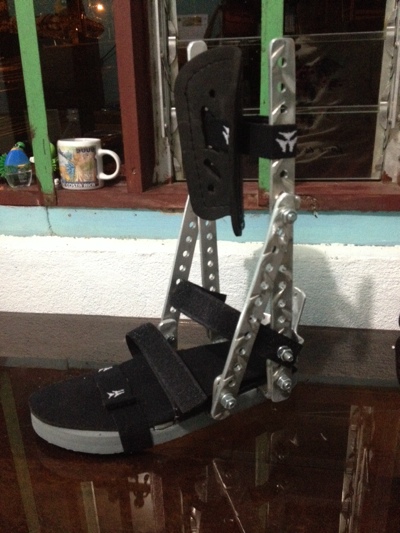
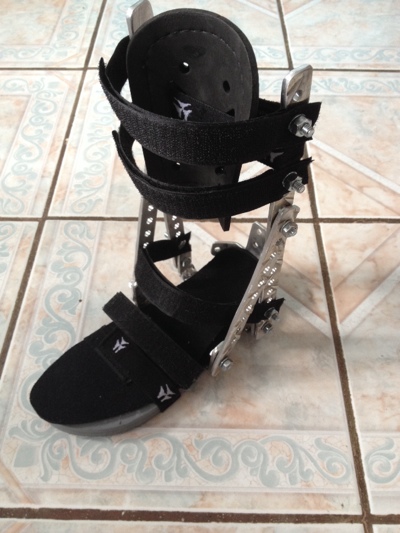
The brace ended up consisting of three primary parts.
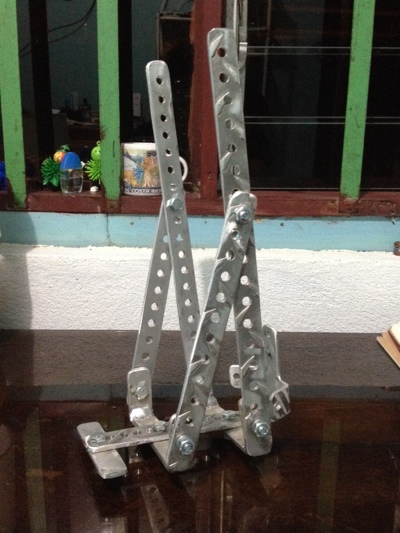
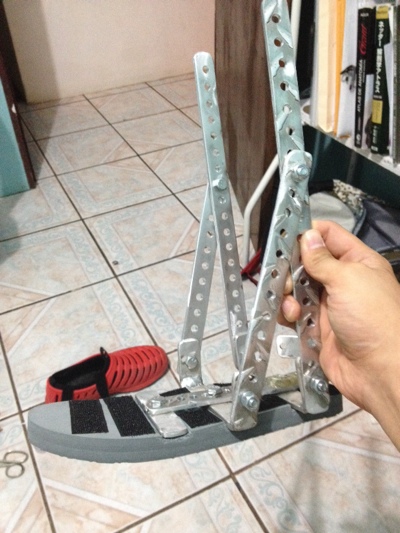
- Upright struts: custom-ordered metal struts (~8,000 yen)
Hardware shops, the medical-supply room behind the pharmacy, the closest thing to a home-improvement store — none stocked orthosis-grade struts. I drew up the specs and ordered them from a workshop in another town. Aluminum, light and easy to machine, but with durability that needs follow-up. - Footplate: cut-down sandal sole
A locally sold beach sandal, with the sole trimmed to match the footplate shape. Building the brace into the shoe itself eliminated the need for shoe-coordination at fitting time. - Lower-leg cuff: baseball elbow protector
An off-the-shelf sports elbow protector repurposed as the calf cuff. The curvature matched the lower-leg form, and the inner padding was usable as-is. Available in any Costa Rican sporting-goods store, and inexpensive.
On top of these, Velcro straps (fastening), additional foam padding (heel pain mitigation), and screws were needed in small quantities. Everything beyond the main three parts could be sourced locally, off the shelf — a major relief.
Build choices and limits
Several judgment calls came up while assembling.
- Fine angle adjustment was given up. Slight misalignment from strut mounting made precise cant and dorsiflexion angle adjustment impractical at the bench level — the limits of handwork
- Heel pain mitigation took priority because of the screw count. Extra footplate cushioning was added to soften contact
- Heel-lift inside the brace was specifically engineered against. If the heel rides up during stance, the brace's function collapses, so Velcro position and tightening sequence were tuned
- Durability was the trade-off for using aluminum struts. Steel would be safer for long-term wear, but I prioritized weight and machinability. For an eight-month "bridge" use case, the trade-off was acceptable
Function check: barefoot vs. braced
After completion, I compared the gait with and without the brace using frontal-plane video.
| Metric | Barefoot | With DIY brace |
|---|---|---|
| Initial contact | Toe-strike (easy to roll the ankle) | Heel strike restored |
| Knee in mid-stance | Hyperextension (with pain) | Hyperextension suppressed |
| Knee pain | Yes | Resolved |
| Brace weight | — | ~700 g |
It was nothing like a properly fabricated orthosis, but it delivered enough function to begin gait training. Once the patient stopped complaining of knee pain, the minimum clinical value of the device was confirmed.
Indications and limits: who is this brace for?
The brace is not for everyone. As a clinical judgment:
Suitable cases
- Mild to moderate hemiplegia where a bridge for gait training is needed until the official brace arrives
- Resource-limited regions where official brace fabrication takes months to half a year-plus
- Patients with relatively low body weight and not extremely high gait volume
Cases that don't fit
- Severe spasticity or significant deformity requiring precise angle control
- Long-term wear (one year-plus) — aluminum strut durability is the constraint
- Activity levels involving competitive sport or long-distance walking
Even after the patient starts wearing it, periodic fitting checks and component wear inspection are mandatory. This DIY brace is intended for use under healthcare-professional supervision and is not a recommendation for patient self-fabrication.
Lessons that stayed
Eight months waiting for an official brace — do nothing, or do what you can? The gap looks small but changes a patient's life.
Building the brace finally gave me a felt sense of how much engineering an orthotist's work actually contains. The small design choices in commercial braces — strut material, ankle joint selection, cuff curvature, Velcro placement — each made sense as an answer at the intersection of field constraints and functional requirements.
WHO estimates that in low- and middle-income countries, only about 5–15% of those who need assistive products actually have access. For the remaining 85–95%, "getting function from materials at hand" is one option that genuinely widens the choice space.
After sharing the gait video on social media at the time, several people reached out asking "where can I buy that brace?" Each of them, presumably, had a family member post-stroke who couldn't walk, who had been waiting for a brace. I considered carving out time to build another one, more than once — but I couldn't find the bandwidth alongside my regular clinical work, and the day to fly home arrived without me getting around to it. The demand was clearly there, but supply was depending on individual goodwill and free time — those messages were the clearest illustration I ever got of that structural problem.
The patient's story and my own reflection on what it meant to work in this system are written up in #8 "Building a Brace by Hand in Costa Rica". The structural issues in Costa Rica's medical system that became visible through the brace are also gathered there.
Background information
※ This section combines public information with the author's notes; please confirm the latest details and statistics on the official sources.
Costa Rica's healthcare system
- CCSS (Caja Costarricense de Seguro Social): Public health insurance, founded in 1941, covering more than ~95% of residents.
- Tiered structure: EBAIS (basic health teams at the village level) → clinics → regional hospitals → national specialty hospitals.
- Orthotics & prosthetics: Public provision exists but procurement times are long; multi-month waits are common in rural areas.
- JICA volunteers: Deployed to Costa Rica from 1965 to today, including many physiotherapists.
Challenges in indigenous territories
- Bribri and Cabécar: Indigenous peoples in the southern mountains; reservations exist around San Vito as well.
- Access: Travel cost and time from mountain villages to specialty hospitals (in San José) is a major barrier.
- Cultural considerations: Coexistence with traditional medicine; decisions are typically family- and community-based.
Why simple, low-cost orthoses matter
- While waiting for a formal orthosis, a "bridge" device has clear clinical value: it keeps functional training going instead of being deferred.
- WHO guidelines also recognize alternative approaches under resource-constrained settings.
- The same techniques carry over to home-based care and disaster response in Japan.
For anyone who wants to relearn orthotics, or master it systematically — this standard reference, supervised by the Japanese Orthopaedic Association and the Japanese Association of Rehabilitation Medicine, is the one to keep within reach for the moments you get stuck in the field. It is a go-to text adopted by training programs for physiotherapists, occupational therapists, and orthotists alike.