In July 2026 I visited the Dominican Republic for the first time. It occupies the eastern two-thirds of Hispaniola, an island in the Caribbean Sea. After years of traveling through Latin America, this was only my second Caribbean island nation, after Belize. My stay centered on the capital, Santo Domingo. Let me start sketching the outline of this country through the old city I walked between meetings, and the "sea-colored stone" I found there.
The Eastern Side of Hispaniola, a Country the Size of Costa Rica
The Dominican Republic covers about 48,700 square kilometers — almost exactly the same size as Costa Rica, as it happens. Its population is about 11.3 million, more than twice Costa Rica's. The official language is Spanish; the currency is the Dominican peso. The western third of the island belongs to Haiti — one island shared by two countries.
The name often gets confused with Dominica, a small island nation in the Lesser Antilles, but they are different countries. The Dominican Republic draws more visitors than any other country in the Caribbean; the resorts of Punta Cana on the east coast receive millions of tourists a year. And it is a baseball nation — no country outside the United States sends more players to Major League Baseball, and on empty lots across the city, kids chase baseballs as a matter of course.
Santo Domingo: The "First City" of the New World
The old quarter of the capital, the Zona Colonial (Colonial City), is one of the oldest cities Europeans built anywhere in the Americas. Its construction began at the end of the 15th century, in the immediate wake of Columbus's voyages, and the New World's first cathedral, first hospital, and first university were all established here. The entire district is a UNESCO World Heritage Site.
Walk the cobblestone streets and you find 500-year-old stone buildings, the fierce Caribbean sun, and music all sharing the same space. Merengue and bachata — both dance musics born in this country, both inscribed by UNESCO as intangible cultural heritage. In the plazas at dusk, it's perfectly normal to see people start dancing to whatever is playing from a speaker. This is a country, I felt, where music lives in daily life as something you dance to, not just something you listen to.
Larimar, the "Stone the Color of the Caribbean Sea"
In a shopfront in the Zona Colonial, one blue stone caught my eye above everything else. Larimar. A semi-precious stone the color of the Caribbean Sea, found only in Barahona Province in this country's southwest — nowhere else in the world.
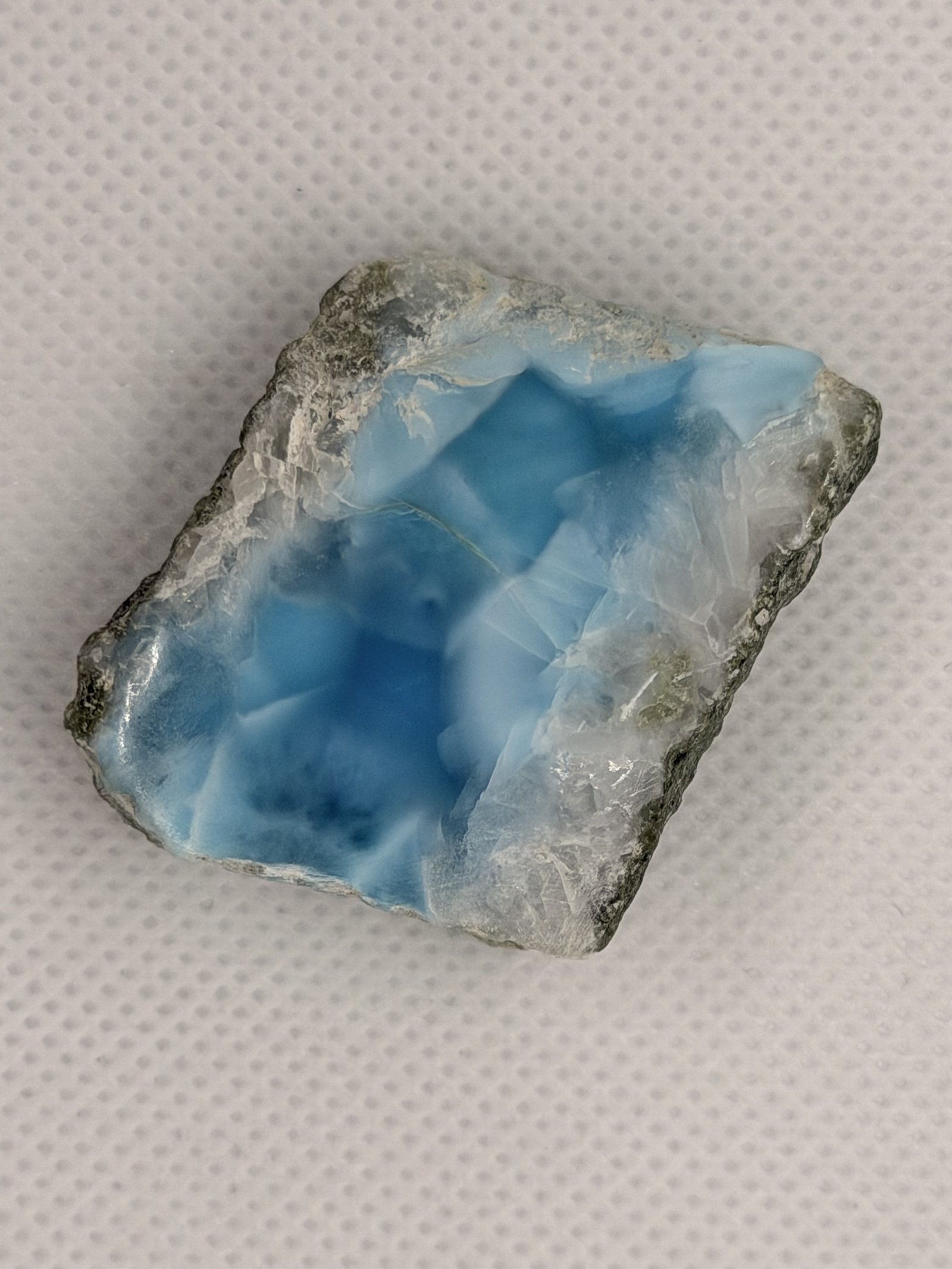
Mineralogically it is a blue variety of pectolite, formed by volcanic activity. It isn't a blue copper mineral; the color comes from trace elements in the stone. The "discovery" story begins in 1974, when a local man named Miguel Méndez and a Peace Corps volunteer found blue pebbles on a beach at the foot of the Bahoruco mountain range. Méndez combined his daughter's name, Larissa, with the Spanish word for sea, mar, and named the stone larimar.
Today it is mined at Los Chupaderos in Barahona Province and sold at every price point in Santo Domingo, from souvenir stalls to fine jewelers. What I chose was not a polished piece of jewelry but the rough stone in the photo. The way the sea-blue spreads like waves across the white host rock feels, to me, more like the sea than any polished stone.
A Country Still to Walk
This stay was mostly work, and I did little that counts as real sightseeing. Even so, the cobblestones of the old city, the music spilling into the streets, and this stone the color of the Caribbean Sea were more than enough reason to come back. The history of an island shared with Haiti, life beyond the resorts, and baseball — there is a lot I want to write about. I hope to walk this country, little by little, through this series.
In this country, the color of the Caribbean Sea survives as stone.
Travel Guide (general info)
※ This section combines public information with the editor's notes; please confirm the latest details on the official sites.
Basics
- Capital: Santo Domingo. There are no direct flights from Japan; connecting through the US (Miami, New York, etc.) is the usual route
- Language & currency: Spanish / Dominican peso (US dollars are widely accepted in tourist areas)
- Best season: the dry season, December–April. June–November is hurricane season
- Safety: tourist areas are relatively stable. As a rule, avoid walking alone at night and steering into empty back streets
Exploring the Zona Colonial
- Cathedral of Santa María la Menor: completed in the early 16th century, the oldest cathedral in the Americas
- Calle El Conde: the pedestrian street running through the old city, lined with cafés and souvenir shops
- Alcázar de Colón: the former residence of Columbus's son Diego, now a museum
Buying Larimar
- Price range: small rough stones and beads start at a few hundred pesos; jewelry varies widely with quality
- Judging the color: stones with deeper deep blue and clearly defined wave patterns are valued more highly than whitish ones
- Caution: imitations such as dyed glass are in circulation. Museum shops and established brick-and-mortar stores are the safer bet