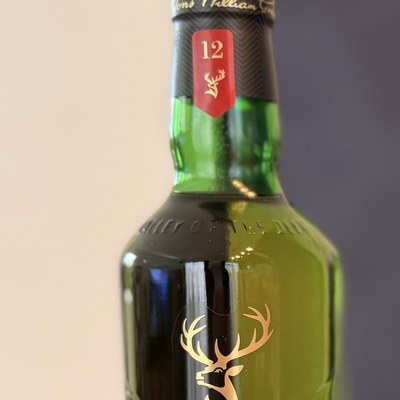
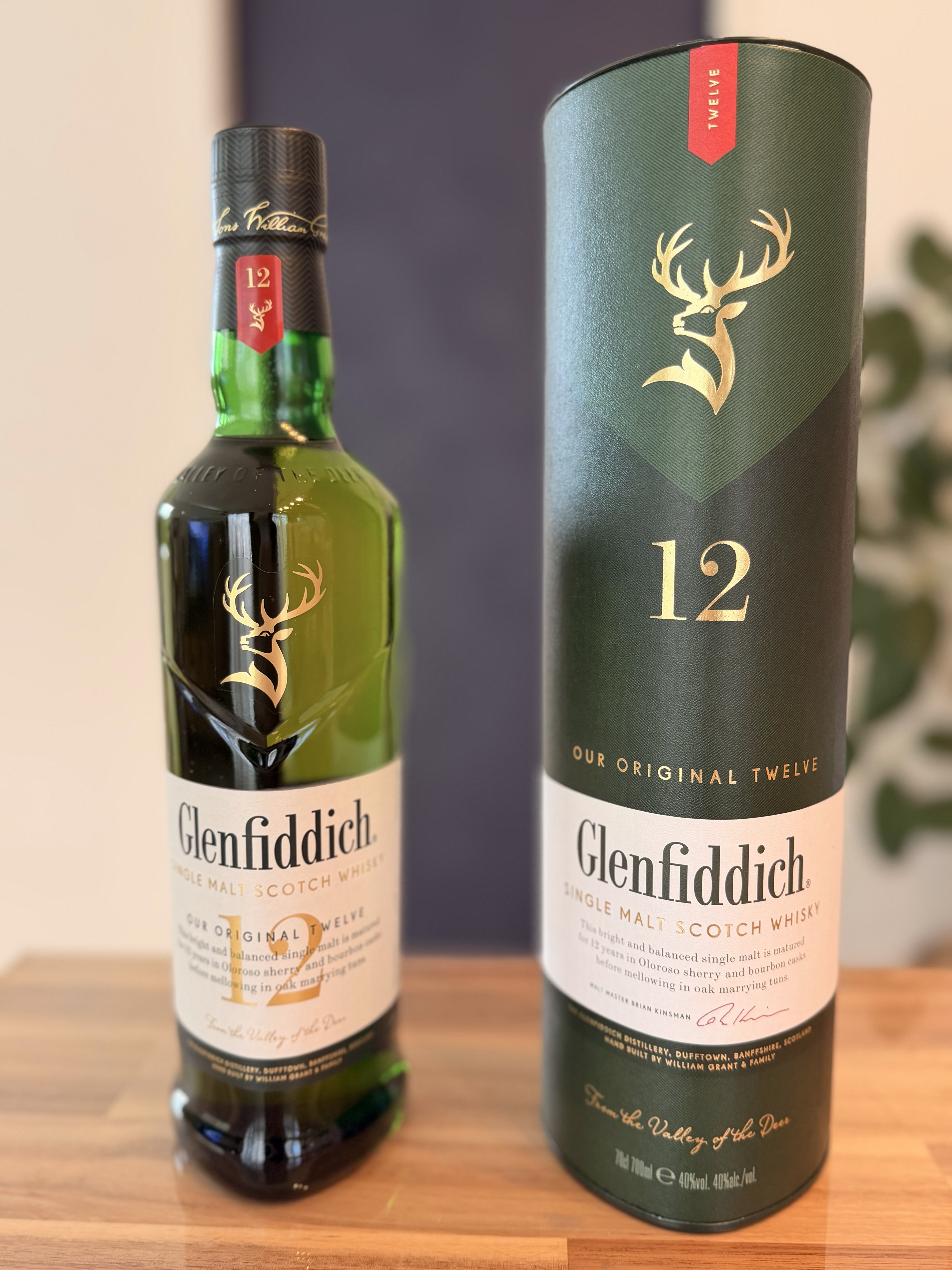
A new bottle joined my shelf: Glenfiddich 12 Year Old. It struck me after opening it — this is probably the first Scotch single malt I drank with the words single malt actually in my head. The first one where the category and the bottle in front of me lined up consciously.
My way into whisky was Black Nikka, and from there I settled into Ballantine's Finest as the everyday pour at home. Tracing the well-trodden blended path felt natural. So when I went to add one more rung to the shelf, what to put there wasn't obvious. What I eventually picked up was the famous green bottle with a stag on the label.
Meeting the idea of "one distillery, one bottle"
I'd known the term single malt for years without it really clicking against what was in the glass. Opening Glenfiddich was the first time I tasted what "a whisky made from malted barley at a single distillery" actually felt like, side by side with the blends I was used to. The contours were clearly aimed in a different direction from the smoothed-out, edge-rounded profile of Black Nikka or Ballantine's.
On the nose, pear and green apple skin, then honey sweetness with a backing of vanilla. On the palate, a fruity sweetness comes up first, then a faint oak bitterness and a touch of wood spice that pulls the finish clean. The finish itself is medium and doesn't linger heavily. At 40% ABV it sits comfortably neat, and yet there's a clear backbone in the aromatics. It's the kind of bottle that quietly explains, in the glass, that Scotch is not synonymous with peat smoke.
Speyside — fruity and honeyed
Glenfiddich Distillery sits in the heart of Scotland's Speyside region, in the town of Dufftown. Speyside is Scotch's most distillery-dense area, gathered along the River Spey as it runs north to the Moray Firth. As a region it tends toward the malty-sweet and fruity end of the spectrum — the opposite pole from peat-heavy Islay — and it's often described as the "easy entry point" into single malts.
The 12-year is traditionally matured separately in American oak (ex-bourbon) and European oak (ex-sherry) casks, then briefly married in large marrying tuns before bottling. The honey and pear up front, with a quiet sherry-cask raisin tone tucked behind it, comes straight from that combination.
For a slow evening I'll take it neat; for a more casual night, on the rocks or with a splash of water. In Japan the highball treatment works too — there's enough flavour density that the aromatics survive the soda. There's a reassuring feeling that the "first bottle" doesn't have to stop at one bottle: this one settles in as a baseline.
Glenfiddich — Background
Lit by William Grant in 1886
Glenfiddich Distillery was built in 1886 in Dufftown by William Grant, a former distillery worker who built the site largely with his family. The distillery's own line is that the first spirit ran on Christmas Day 1887. It's still owned and run by the founding family's company, William Grant & Sons — unusually so for a distillery of this size.
"Valley of the Deer" — a Scottish Gaelic name
"Glenfiddich" comes from the Scottish Gaelic Gleann Fhiodhaich, meaning "Valley of the Deer." That's where the stag on every bottle and box comes from. It sits within the broader Speyside tradition of "Glen-" (valley) place names, alongside Glenlivet, Glenfarclas and many others.
One of the bottles that put single malt on the map
For most of Scotch's modern history, single malts were largely used as components of blended Scotch. Glenfiddich is widely credited as one of the first distilleries to deliberately market single malt as an international, consumer-facing category, beginning in 1963. The Scotch Whisky Association and several whisky historians point to this period as the start of single malt as a recognisable consumer category.
Marrying tuns and the bourbon-plus-sherry combination
The 12-year is matured in first-fill and refill ex-bourbon American oak and ex-sherry European oak casks, then married in large oak tuns before bottling. The fruity honey with a quiet dried-fruit tone behind it comes from that combination, and the bottle is a useful way to understand single malt as something where the cask choice carries a lot of the character.
A reassuring baseline for home drinking
Single malts vary enormously distillery by distillery, and the bottle you choose first quietly shapes how you read everything afterwards. Glenfiddich 12 lays out the Speyside profile — fruity, honeyed — clearly enough to be a reference point without becoming generic. It still has a recognisable house style. Before stepping toward Islay peat or the more austere Highland side, it's a good place to come back to.
Distribution in Japan is reliable to the point of ubiquity — liquor shops, supermarkets, convenience stores, airport duty-free. The price for a 12-year single malt is friendly enough to keep it on the shelf as a default. If someone asked me what to pick as a first single malt, I'd point at this one without hesitation.
700 ml in a presentation tube, the standard JP import. A reliable Speyside single malt and a useful baseline to drink against the rest of the shelf.