August. I went to the Tsunan Sunflower Plaza in Tsunan, Nakauonuma District, Niigata. About 650,000 sunflowers bloom together across the farmland — a summer event known for the dramatic backdrop of the Echigo mountains.
A field of sunflowers
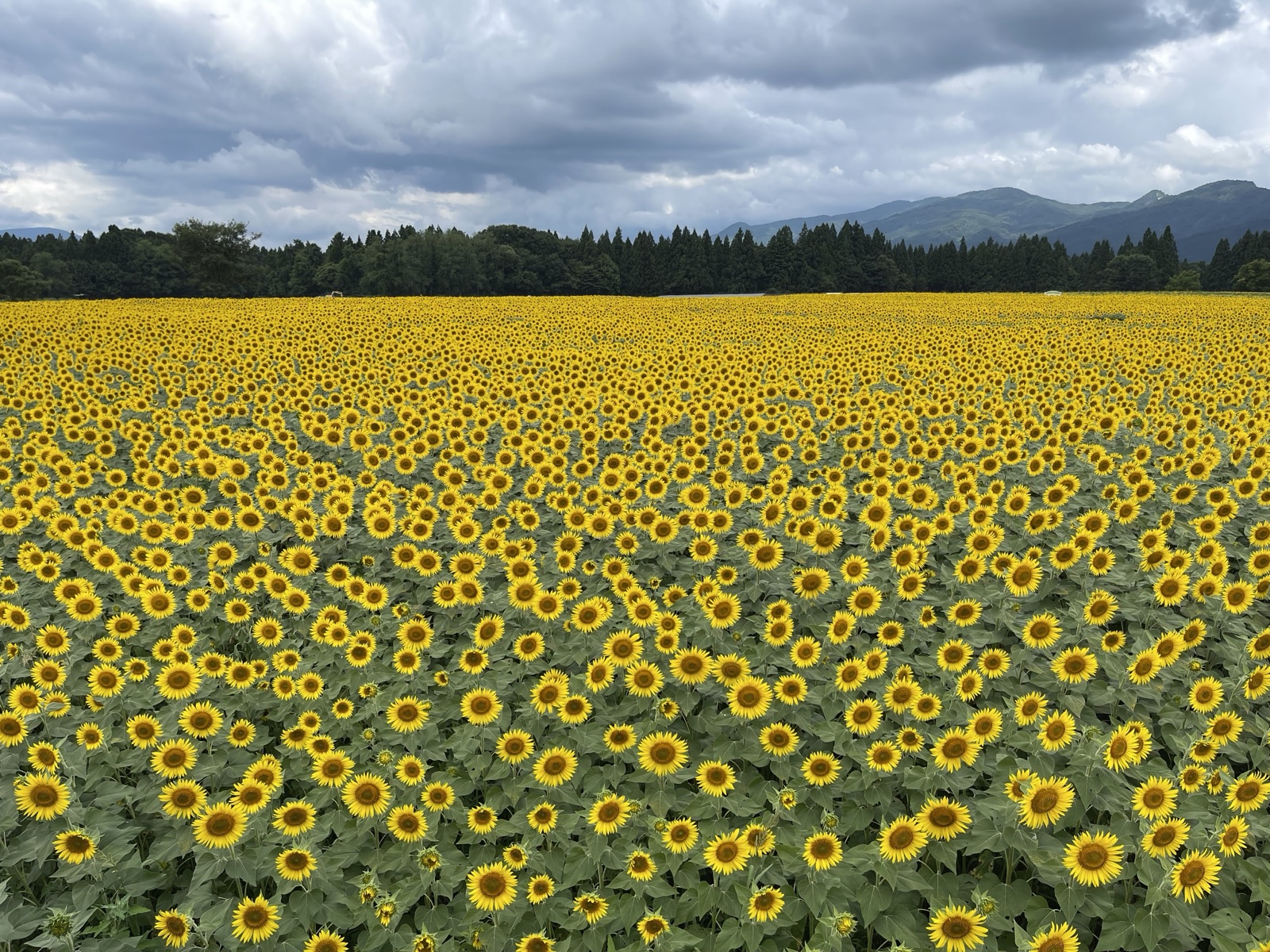
The moment I got to the field, my entire field of view turned yellow. A flat sea of sunflowers stretching out, and the green of the mountains layered behind it. Bigger in scale than I'd imagined.
Tsunan plants its sunflowers across terraced fields, so each section blooms on a slightly different schedule. By design — early-blooming through late-blooming — the peak window stretches across early to mid-August.

Mostly cloudy, but when the sun broke through, the yellow flared. Sunflowers track the sun, so they face east in the morning and west in the afternoon. Visit in the morning and they're aimed straight at you for the camera.
Summer in Tsunan
Tsunan sits in the inland southern part of Niigata, in mountain country close to the Nagano border. In winter it's one of the heaviest snow regions in Japan; in summer it's lush highland scenery. Yellow sunflowers spreading out against those green mountains is a combination you won't see anywhere else.
The sunflowers are roughly adult-height, so once you step into the field everything around you becomes sunflowers. Standing in the middle of that, you feel summer's force in your whole body.
The next day, to the Nagaoka Fireworks
On August 3, I moved on to Nagaoka City. That day was the second night of the Nagaoka Festival Grand Fireworks — counted among Japan's three great fireworks festivals, and originally started as a memorial to the victims of the 1945 Nagaoka air raid and a vow to rebuild. Across the two nights, attendance is said to top a million.

The fireworks launch from the Shinano River bed, and the scale is something else. The pressure of the sound is on a different level. The vibration reaches into your chest. No amount of repeat viewing makes that feel ordinary.

Fireworks photos courtesy of: junichi-m.com
The day before I'd been in the middle of a sunflower field; the next night I was under fireworks. Both very Niigata-summer scenes — but completely different kinds of overwhelming.
Travel guide (general info)
※ This section combines public information with the author's notes; please confirm the latest road, weather, and operating details on the official sites.
Tsunan Sunflower Park highlights
- Location: Ashigasaki, Tsunan-machi, Nakauonuma, Niigata — on the Okinohara terrace, an area also known for Jōmon-period sites.
- Scale: about 500,000 sunflowers planted in stages over roughly 4 ha, giving a long bloom window.
- Period: typically late July to mid-August (varies by year — confirm on the official site).
- Fee: a small cooperation fee (a few hundred yen). Parking on site.
Nagaoka Fireworks Festival
- History: descended from the "Nagaoka Reconstruction Festival" memorialising the August 1, 1945 air raid. Held every August 2 and 3 along the Shinano River bed.
- Scale: one of Japan's three great fireworks festivals (with Ōmagari and Tsuchiura). Signature programmes include the "Shōshakudama" (90 cm shell) and "Phoenix".
- Viewing: paid seats are mostly by advance lottery; same-day sales are limited and very crowded.
- Symbol of recovery: the "Phoenix" segment, born after the 2004 Chūetsu earthquake, is now a fixture.
Access & lodging
- To Tsunan: about 40 min from Shiozawa-Ishiuchi IC (Kan'etsu Expressway) via Route 353. About 10 min by taxi from Tsunan Station (JR Iiyama Line).
- To Nagaoka: walk to the venue from Nagaoka Station (Jōetsu Shinkansen). Major road closures around the venue on festival days.
- Lodging: rooms across Nagaoka, Niigata City, and Yuzawa fill up well in advance during the festival — plan 6–12 months ahead.
- Tsunan to Nagaoka: about 2 h by car; via Echigo-Kawaguchi if combining Shinkansen and JR.