June 2015. About a three-hour flight from Costa Rica. Using a long break from work, I went to Mexico for the first time. Mexico City, where I landed, sits at 2,240 m above sea level — a sprawling capital with thin highland air. From a Central American perspective it can feel like "the Spanish-speaking country next door," but the depth of civilization here is on a whole different scale. With that hunch in mind, the first place I headed on day one was the Museo Nacional de Antropología (National Museum of Anthropology).
Tucked into one corner of Chapultepec Park, this is the institution that embodies Mexico's pride in its own past. It covers everything from ancient Mesoamerica to Indigenous cultures across the country, and is regularly ranked among the great museums of the world. The building itself, designed by architect Pedro Ramírez Vázquez and opened in 1964, is considered a landmark of modern Mexican architecture; the central umbrella-like column shelters a vast forecourt under a single piece of inverted-cone roof.
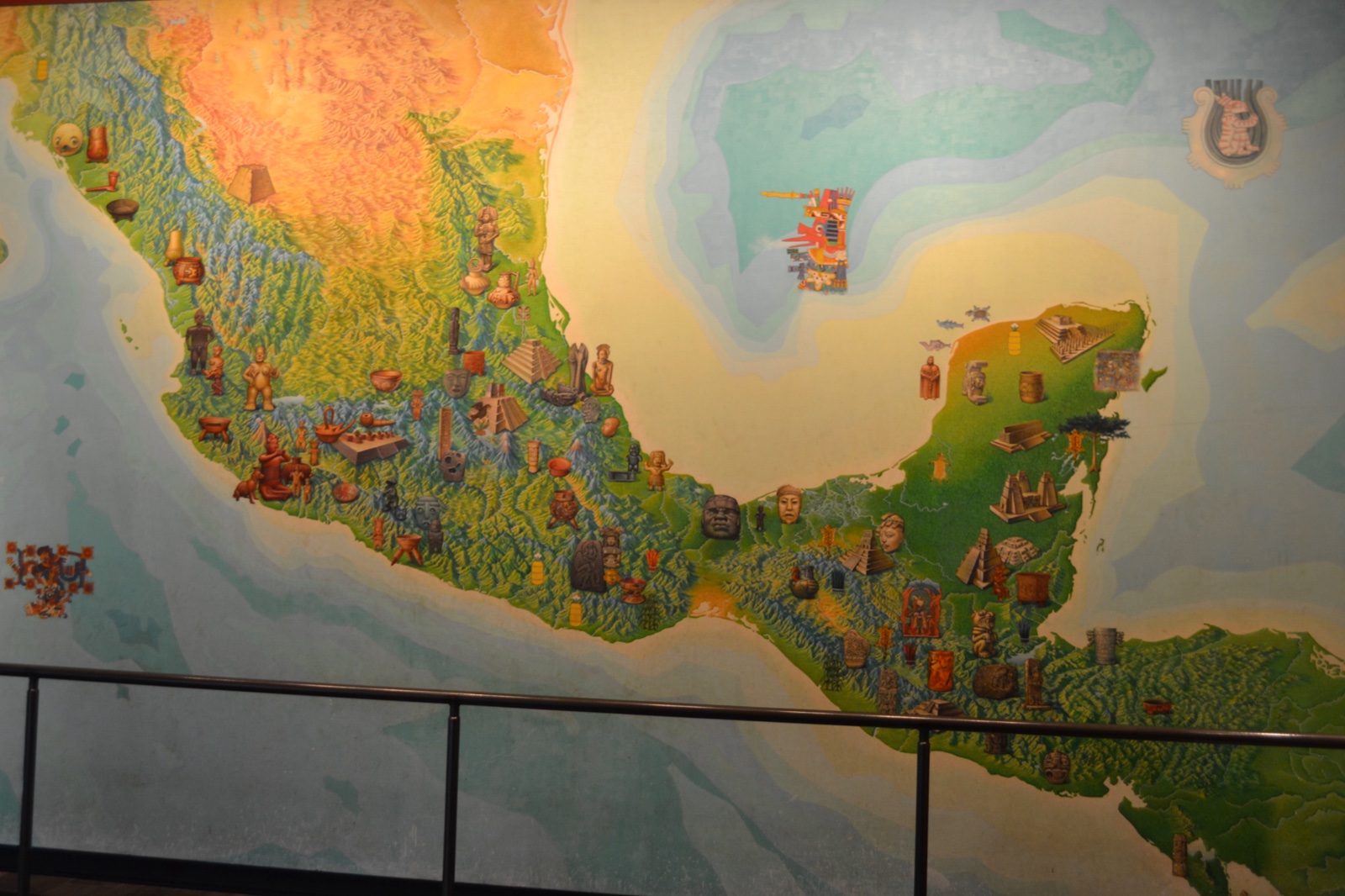
An overwhelming concentration of antiquity
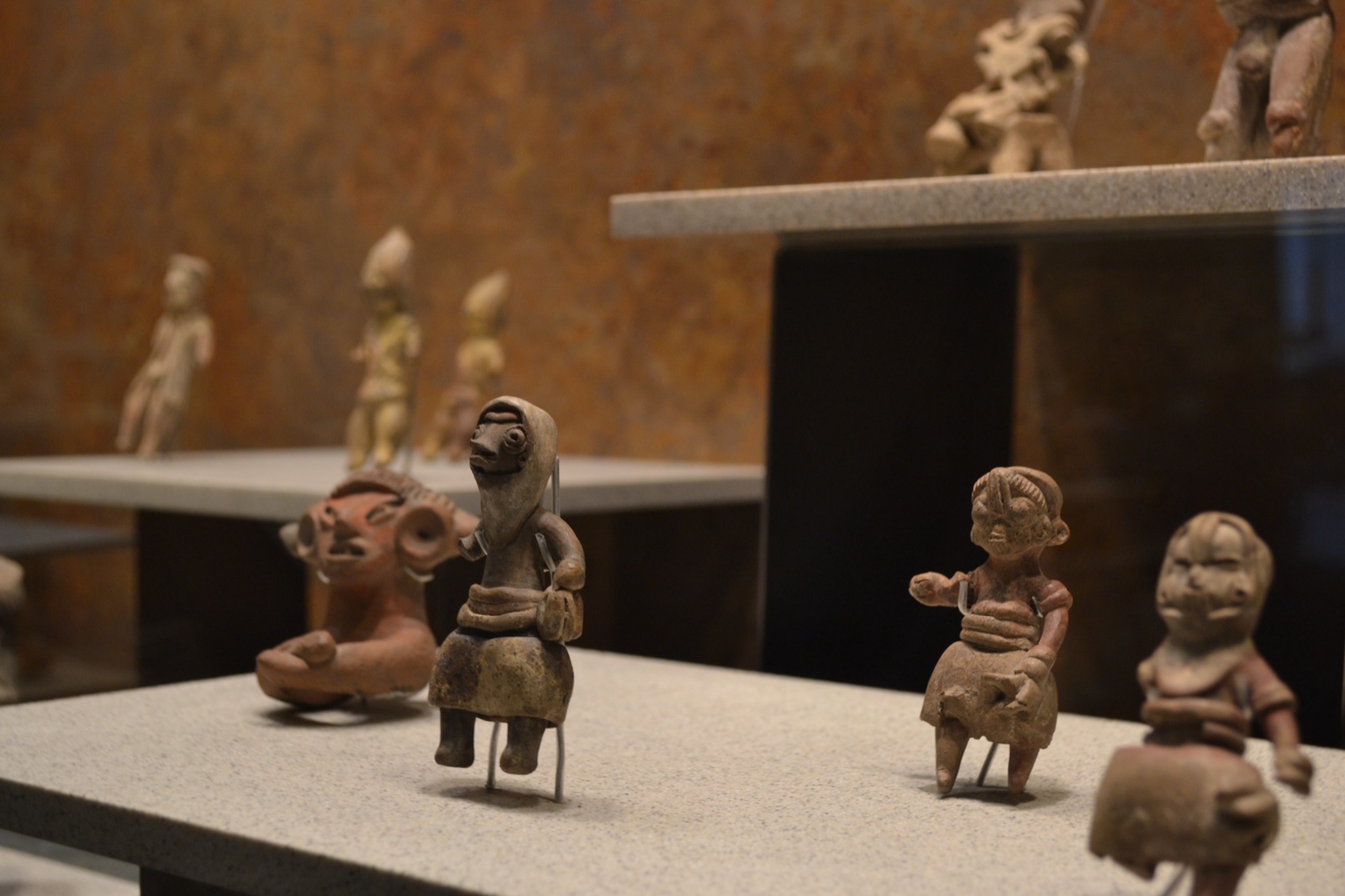
The depth and breadth of the displays is staggering. Aztec, Maya, Olmec, Teotihuacan, Zapotec, Toltec — civilizations whose names you only knew from a textbook line up here in real artifacts behind a single sheet of glass. "Seeing the real thing" doesn't quite capture it; the air itself feels denser.
The Sun Stone — the Aztec circular calendar
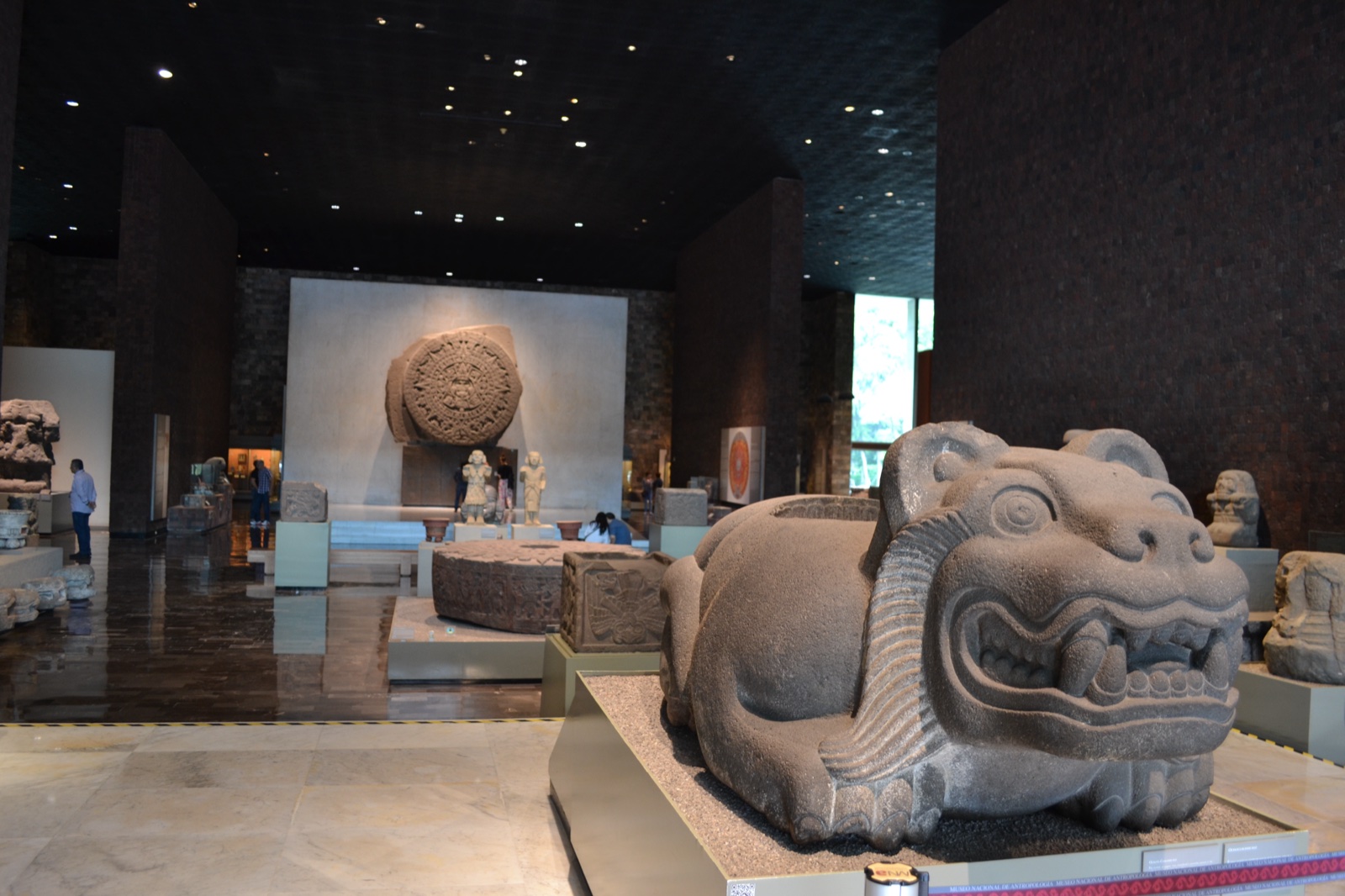
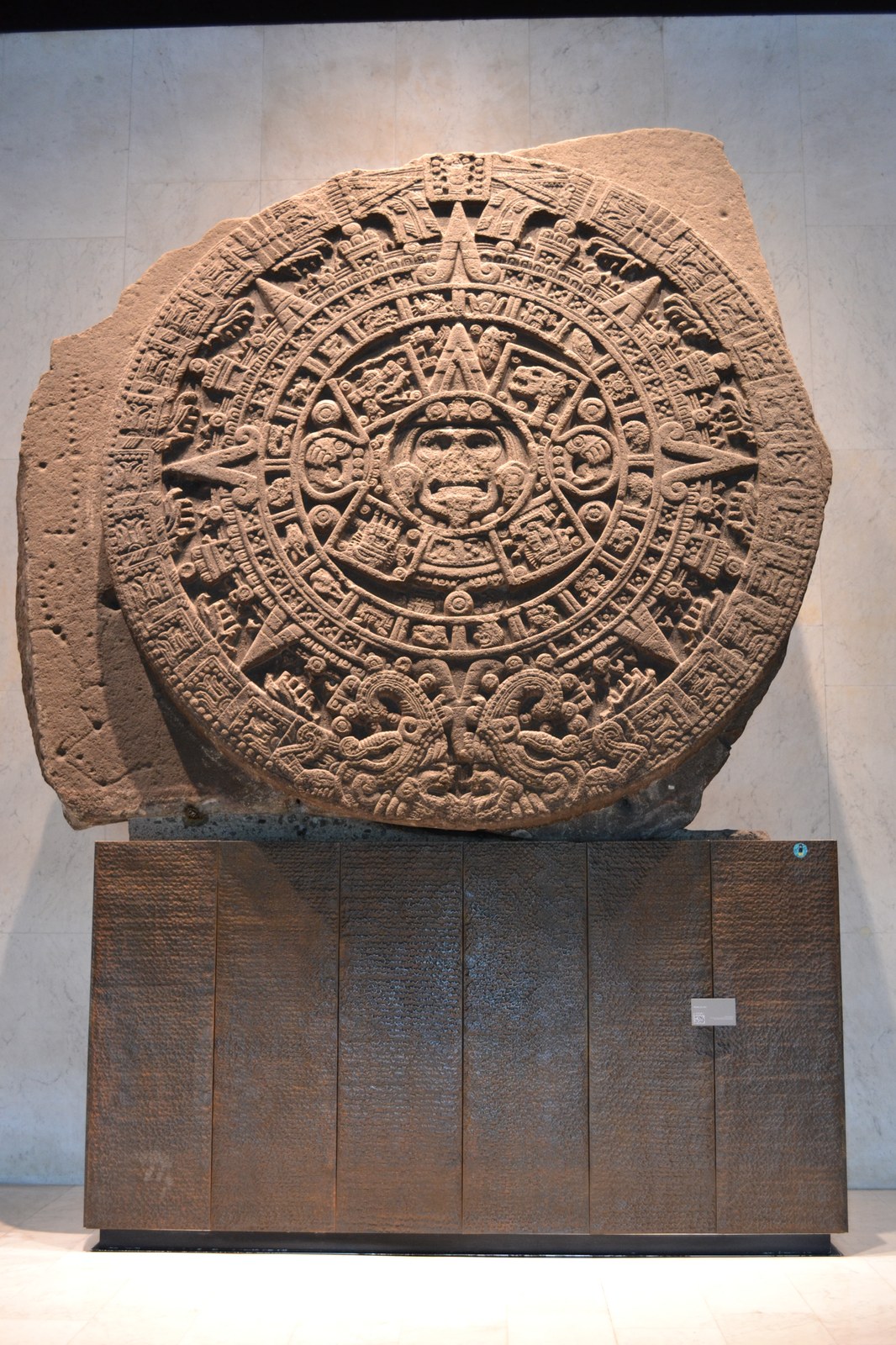
The museum's signature exhibit is the Sun Stone (Piedra del Sol). A single 3.6 m wide, 24-ton monolith carved with an entire Aztec cosmology. At the center is the sun god Tonatiuh, surrounded by the four previous suns (eras) and the symbol of the current fifth sun. Outside that ring sit the twenty day-names, and on the outermost edge two serpents wrap around the universe — the structure of the world itself, packed into one stone. An astonishing object. Its history is striking too: it was unearthed in 1790 in Mexico City's Zócalo, having been buried in the ground after the Spanish conquest along with the destruction of the Templo Mayor; it then spent nearly two centuries in various locations before reaching the museum.
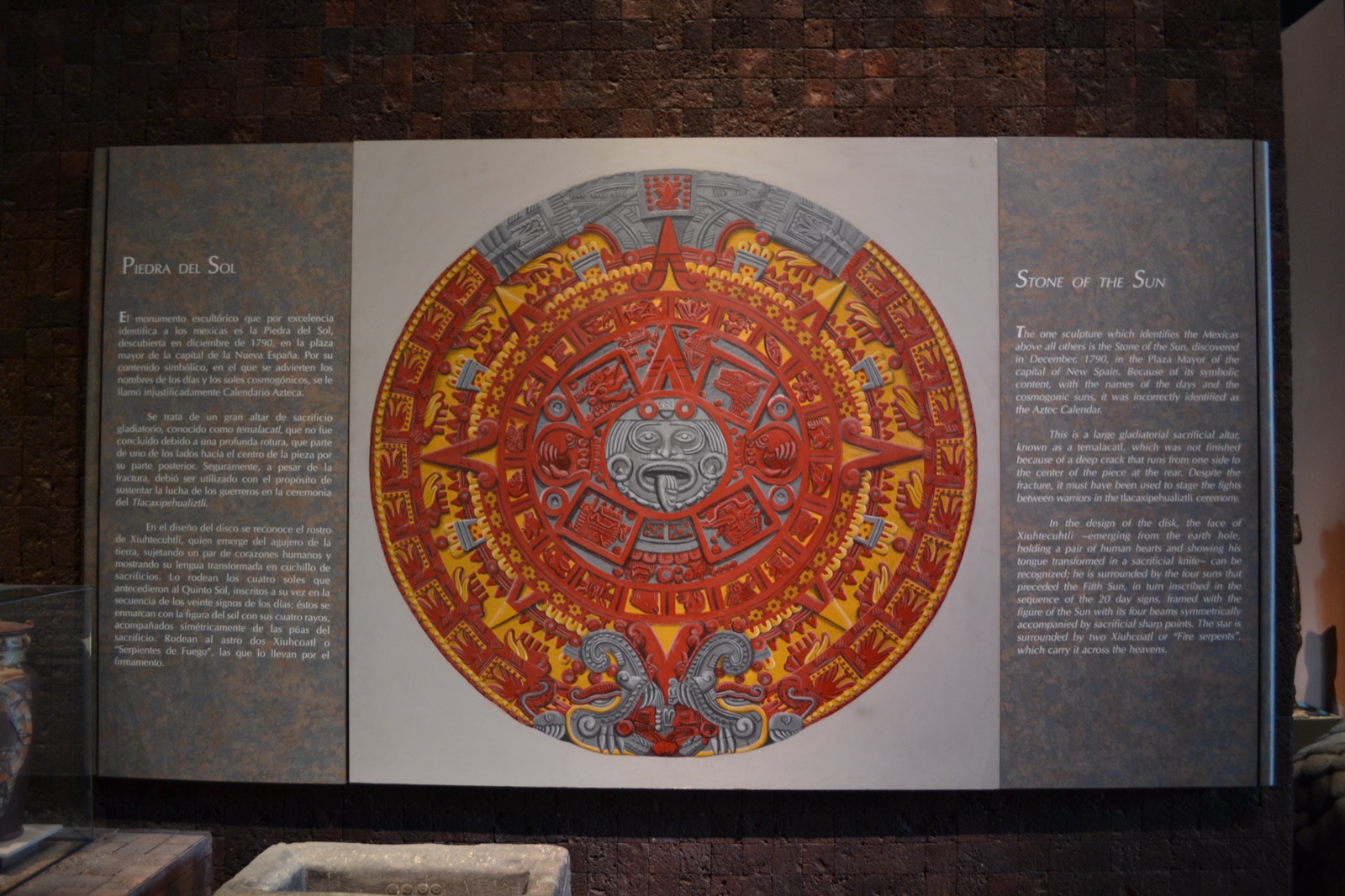
It left such a strong impression that later, while browsing a souvenir shop on the Yucatán Peninsula, I didn't hesitate to buy a miniature Sun Stone fridge magnet. It's still on my refrigerator today.
Coatlicue and the Olmec colossal heads
Standing alongside the Sun Stone in sheer impact are the Coatlicue statue and the Olmec colossal heads.
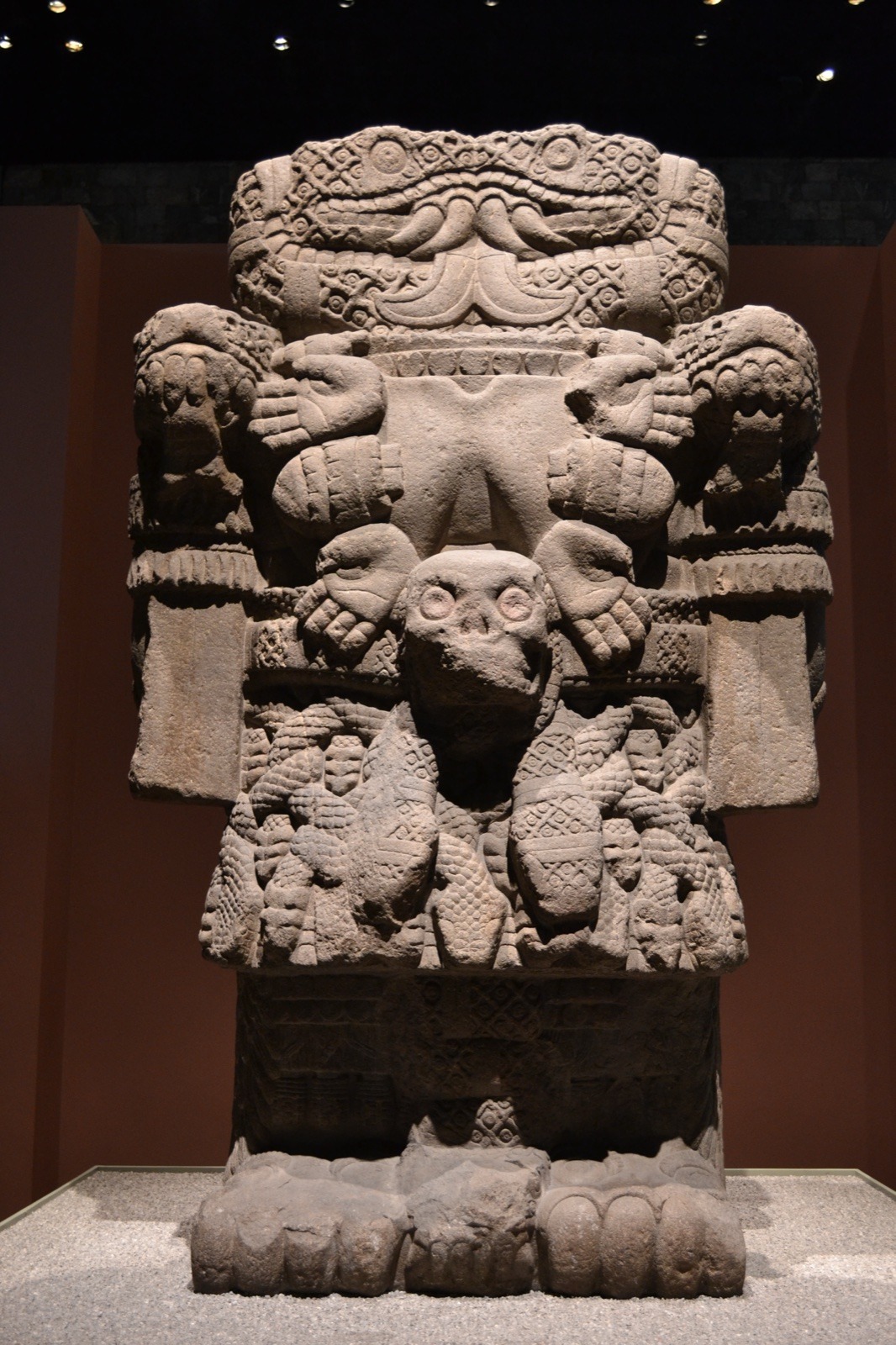
Coatlicue is the Aztec earth mother. Her head is rendered as two snake heads joined together, her necklace is strung with human hearts and severed hands, and her belt is made of skulls. An ancient view of life and death, sculpted with no filter — the sort of figure that overwhelms you just by being in front of it. She was unearthed in 1790, almost simultaneously with the Sun Stone, beneath the Zócalo.
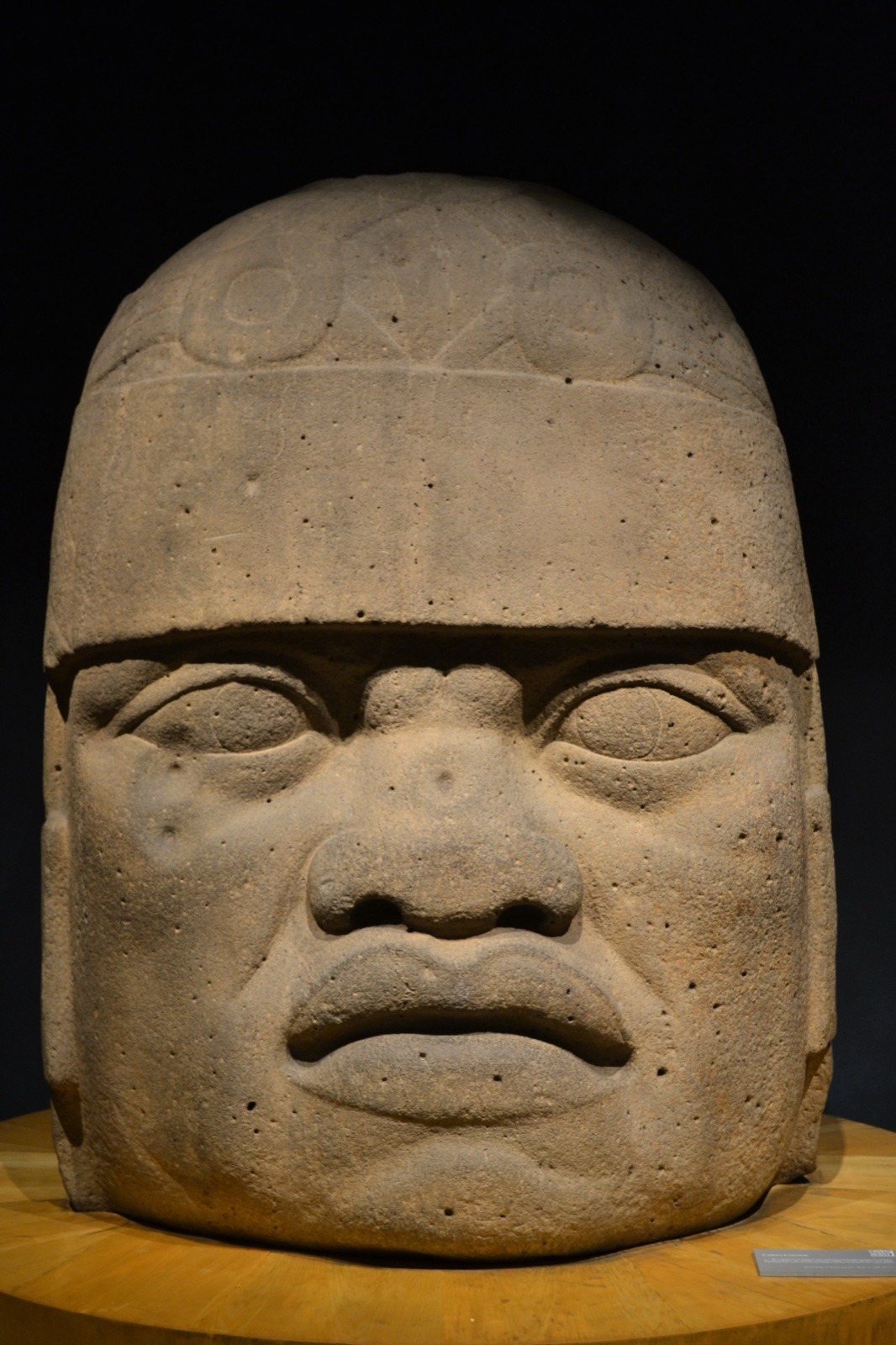
The Olmec colossal heads, meanwhile, were left behind by Mexico's oldest civilization — the Olmec (around 1500–400 BCE). Over 3,000 years ago, someone carved a human head, scaled up to roughly 2 m tall, out of a single block of stone. Wide noses, thick lips, a helmet-like cap. Seventeen colossal heads have been documented to date, from sites including San Lorenzo, La Venta, and Tres Zapotes. Each was hauled from quarries dozens of kilometers away — yet the Olmec had no wheel and no large draft animals, and how exactly they were transported is still unresolved. Some have read the features as African, fueling debate over ancient cultural exchange that continues to this day.
Skulls and death deities — Mexico's view of mortality
One motif keeps appearing through the galleries: the skull. Skulls as ornament, skulls as gods, skulls as the boundary between life and death. The sensibility we now know from modern Mexico's Día de los Muertos was already in place in ancient Mesoamerica.
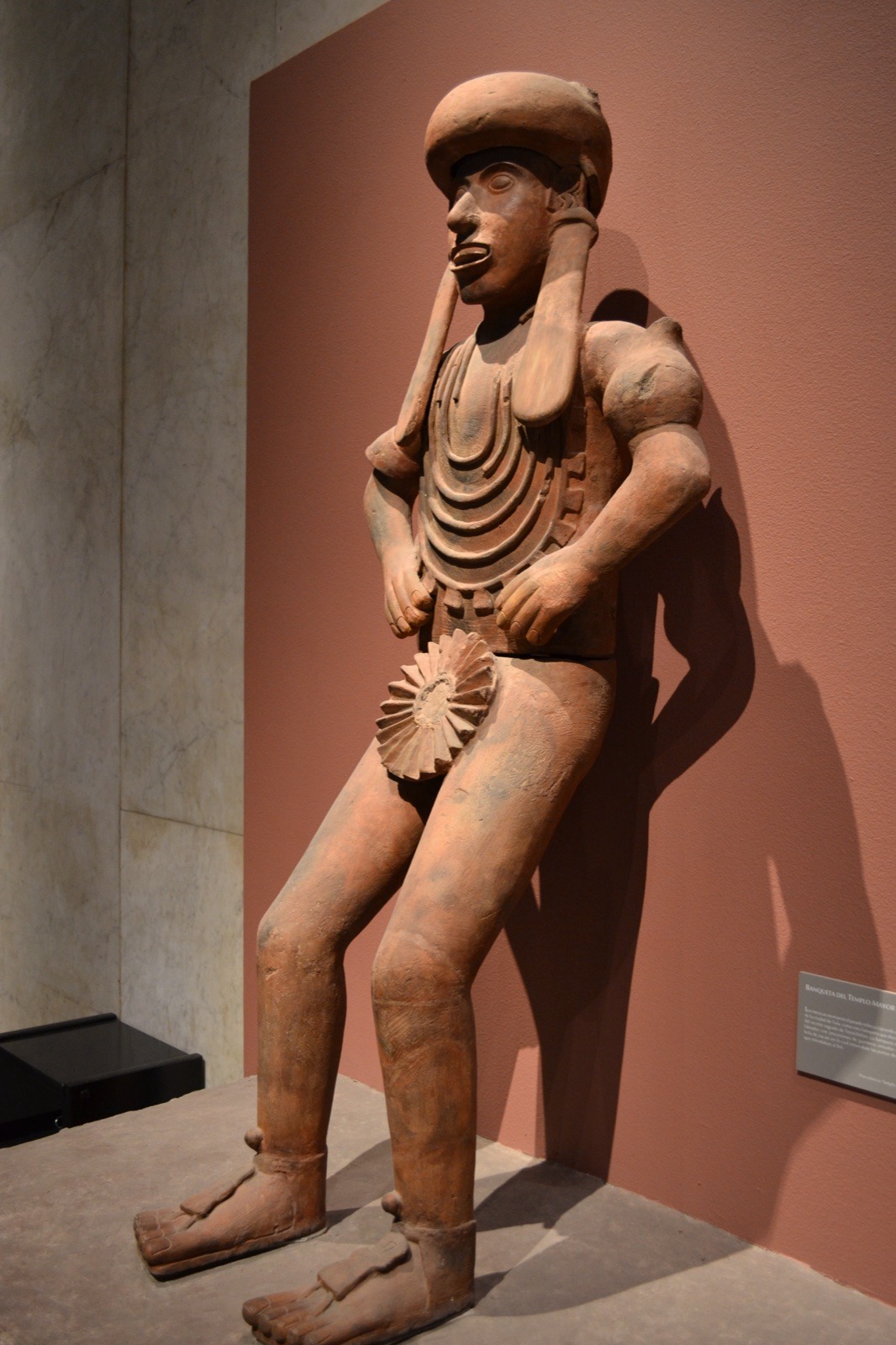
The clearest example is a display tied to the Aztec lord of the underworld, Mictlantecuhtli. The museum holds a life-size ceramic figure of a priest serving the death deity, dressed in Mictlantecuhtli's regalia and emblems. Rather than an image of the god himself, it's better understood as a human figure embodying death-related divinity in a ritual setting. It's not a literal skeleton, but the rigid posture and distinctive ornaments still convey the Mexica ritual world built around death.
For an even more literally skeletal representation of Mictlantecuhtli, the Templo Mayor museum has a piece I've shown in Mexico City Historic Center: Walking the Zócalo, Templo Mayor, and Cathedral — Mexico Tour Notes #1.
Death not as fear or taboo, but as something that lives right next to life — that aesthetic feels like a single thread running unbroken from the Olmec 3,000 years ago all the way to the Catholicized Mexico of today.
On day one in Mexico City, this museum hit me with the full thickness of "Mexico" all at once.
From here on, every street I walked and every site I visited would feel like an extension of what I saw inside these halls — the perfect place to start a journey.
Places visited
Travel notes (general info)
※This section is editorial reference based on public information. Please confirm prices and operating details on official sites.
Getting there
- Metro: Auditorio station (Line 7), 10 min walk; or Chapultepec station (Line 1), 15 min walk
- Metrobús: Antropología station (Line 7), right at the entrance
- Taxi/Uber: 15–25 min from the city center (40+ min in heavy traffic)
- Admission: about MX$95 for foreign visitors (2024). Free on Sundays for Mexican citizens and residents
- Allow: at least 3 hours for the major exhibits; half a day to a full day to take it in properly
Recommended nearby spots
- Chapultepec Castle (Castillo de Chapultepec) — Mexico's only royal residence-castle; once the seat of Emperor Maximilian. Houses the National History Museum
- Museum of Modern Art (Museo de Arte Moderno) — holds Frida Kahlo's "The Two Fridas," 10 min walk away
- Tamayo Contemporary Art Museum (Museo Tamayo) — modern collection donated by painter Rufino Tamayo
- Soumaya Museum (Museo Soumaya) — Carlos Slim Foundation's mirrored-facade landmark in Polanco. Free admission
- Chapultepec Park (Bosque de Chapultepec) — one of Latin America's largest urban parks; also includes the zoo and botanical garden
References
- National Museum of Anthropology — Official site (INAH)
- INAH (Mexico's National Institute of Anthropology and History)
- Encyclopædia Britannica — Sun Stone
- Encyclopædia Britannica — Coatlicue
- Encyclopædia Britannica — Olmec
- Encyclopædia Britannica — Aztec
- Mary Ellen Miller, Maya Art and Architecture (Thames & Hudson, 2nd ed., 2014) — overview of Maya and Mesoamerican art on display at the museum
- Michael D. Coe & Stephen Houston, The Maya (Thames & Hudson, 10th ed.) — the standard, readable introduction to ancient Maya archaeology, art and religion