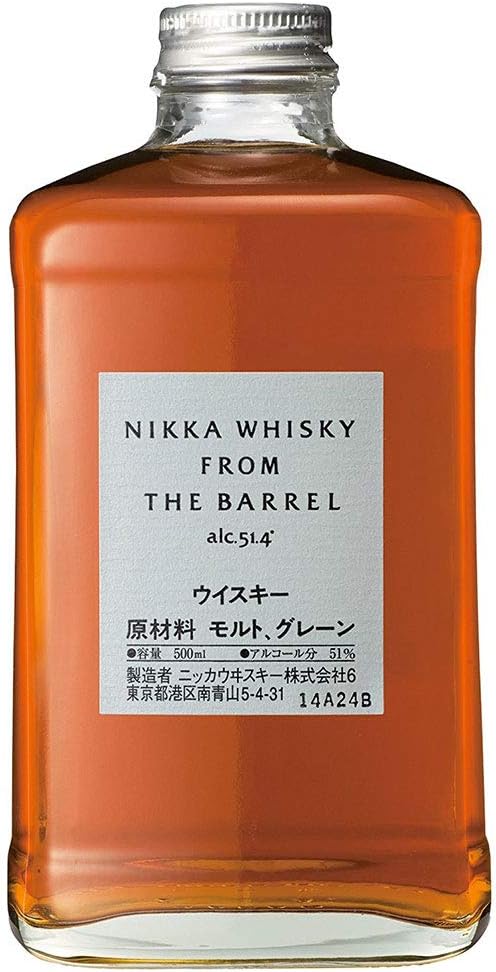
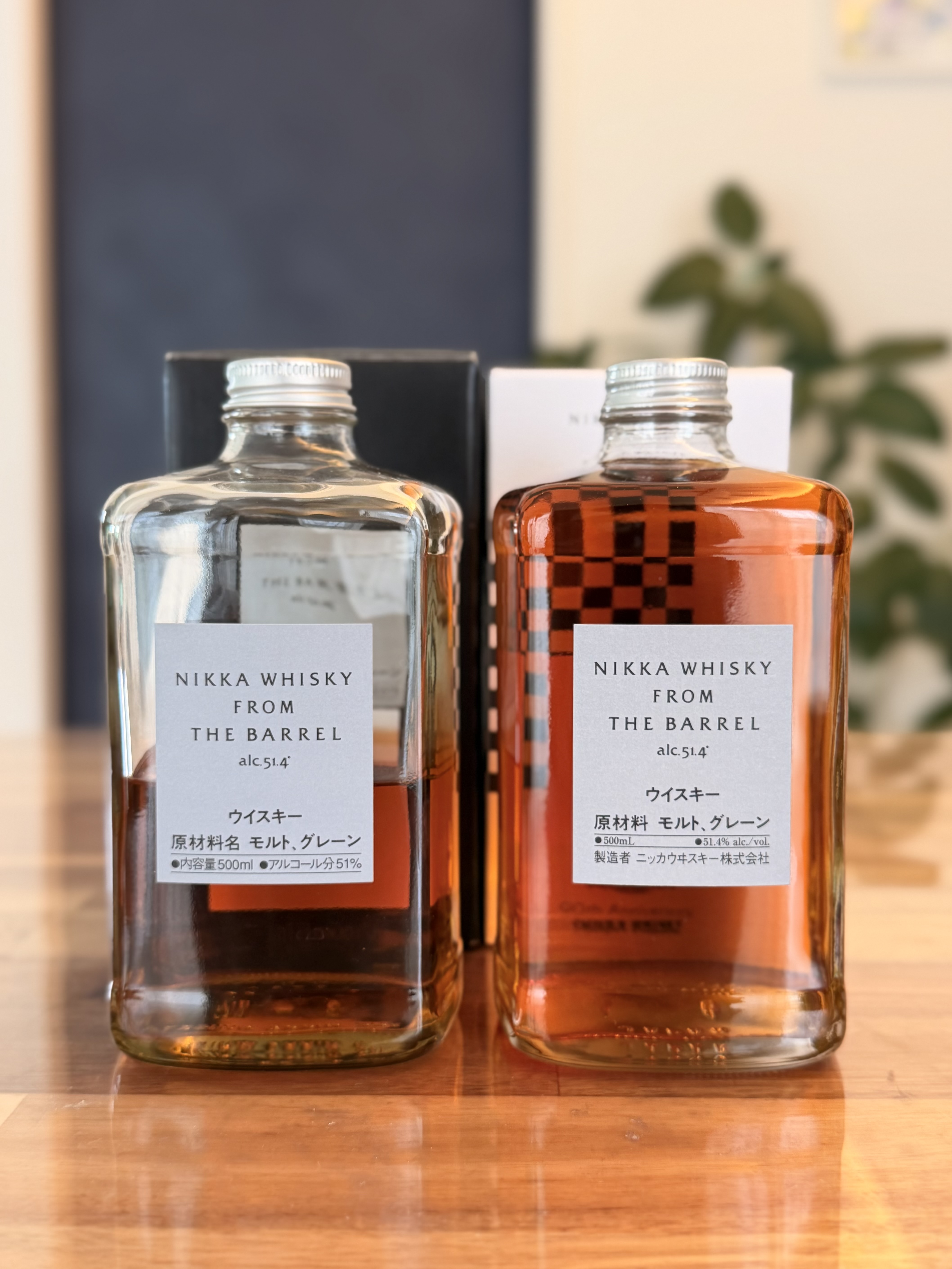
Nikka Whisky's globally-respected blend, From The Barrel. The reputation has only grown, and in recent years it's been hard to buy at the original retail price even inside Japan. I've got two of them on the shelf — the Japanese-domestic bottle on the left, the parallel-import bottle on the right — so I lined them up and looked at the bottles, the boxes, and what's inside.
The real difference is the box
What surprised me lining them up was that the front of the bottle labels look almost the same. The Nikka logo placement, brand name, and ABV (51.4%) are essentially identical between the domestic bottle (left) and the parallel-import bottle (right). The actual differences sit in the small print on the back: the importer notice, country-of-origin text, EAN/barcode for the European market — fine details, not anything you'd notice from across the room.
Where the difference is obvious is the outer box design. The parallel-import box (right) is built for European retail with different colour blocking and Nikka logo treatment from the domestic version. The Japanese-domestic box (left) uses the standard JP-market design. Stand them side-by-side on a shelf and the box is what tells you "ah, these are different" before the bottles do.
Bottom line: the liquid in both bottles is the same, as I understand it. Production batch, shipping route (temperature history during sea freight), and storage time can introduce subtle differences, but the recipe and ABV are unified under "Nikka From The Barrel." When the parallel import is cheaper, the difference comes from customs and distribution margins, not the contents.
"Re-vatted" — the unusual second-time-in-cask process
The defining trait of From The Barrel is Nikka's signature Re-vatted process. A typical blended whisky is "blend the malt and grain whiskies, then bottle." From The Barrel blends them, then puts the blend back into casks for several months before bottling. The malts and grain whiskies integrate, and the result is a denser, smoother character.
The unusually high ABV — 51.4% — is also worth noting. The bottling involves only minimal water addition, so the spirit goes into the bottle close to cask strength. The product name ("From The Barrel") is meant literally.
On tasting, the nose is vanilla, sherry, nuts, a slight peat. On the palate: sweetness and density up front, then spiciness from the high ABV and a wood note. The finish is long, with dried fruit and cacao. Packing this much density into a small 500 mL square bottle (with the 180 mL-style cap) is, on price-to-quality, almost criminal.
It picked up the UK Whisky Magazine's "Best of the Best" in 2015 (with earlier laurels too), and around 2018 it became chronically out of stock. Bottles travel back to Japan as parallel imports — that's the kind of global tug-of-war this one ended up in.
People love to argue over which is "the real one" between parallel import and domestic — but both are real Nikka, both shipped to the world by Nikka. The only differences are packaging and what route they took to get to the glass; the moment it's poured, that gap pretty much closes. Getting to line them up and taste them at home was, in its way, a small luxury.
From The Barrel — Background
※ This section combines public information with the author's notes; please confirm the latest details on the official sites.
Release history
Launched in 1985. Built from Nikka's Miyagikyō and Yoichi distillery malts plus its own grain whisky, then re-aged in cask after blending — the "Re-vatted" method. Long positioned as an affordable domestic blend in Japan, the worldwide acclaim came from its export markets and was effectively re-imported.
Awards and reception
Whisky Magazine "Best of the Best 2007" winner; multiple top placings in World Whiskies Awards categories. Particularly popular in Europe (especially France), where it's recognized as a flagship of Japanese blended whisky.
Parallel-import vs. domestic differences
The liquid is identical. The differences are mainly (1) the outer-box design (JP-domestic vs. export-market style), (2) small print on the back label (importer notice, barcodes, etc.), (3) shipping route and temperature history during transport, and (4) retail price. Parallel-import bottles can be cheaper than domestic, but since you can't verify shipping conditions there's a chance you receive a long-stored individual bottle.
Now that supply has settled, the 500 mL bottle is much easier to find on Amazon — and you can pick the parallel-import or the domestic version.