The same license — "physiotherapist" — but change the country and the whole landscape of the job changes. Working for two years in San Vito in southern Costa Rica (Costa Rica Stories #3), what made me think the most wasn't braces or systems, but the very shape of "physiotherapy as a job."
A Country Where Going Independent Is Allowed
When I worked in Japan, a physiotherapist was almost always someone "affiliated" with a hospital or facility. So it surprised me, arriving in Costa Rica, that it wasn't unusual for physiotherapists to run their own private clinics.
Costa Rica has no law prohibiting physiotherapists, occupational therapists, or speech-language therapists from opening independent practices. So private clinics stand out. As best I remember, a private session ran on the order of 3,000–4,000 yen per hour (that's only my sense of it at the time; the actual fee varied by period and clinic). It was a starting point completely different from the Japanese assumption that "rehab is something you receive at a hospital."
What You're Taught to Treat as "Important" — A Different Yardstick
One day, out of the blue, my supervisor asked me: "A Costa Rican physiotherapist has come to San Vito for training — would you work alongside her?" She was a physiotherapist full of drive, and her ambition and sharp mind were a good stimulus for me.
At the same time, I increasingly felt there was something amiss with the universities teaching physiotherapy in Costa Rica. Since it feels presumptuous to declare "there's a problem" from a Japanese standpoint, let me put it more precisely: what they treated as important was quite different from Japanese training.
For example, MMT (manual muscle testing), ROM (range of motion), tendon reflexes, movement observation, transfer/handling technique — and even blood-pressure measurement and risk management — were things that people holding a physiotherapy license mostly couldn't do. She told me, "ROM was just something we glanced at in a textbook; I never thought it was such an important assessment."
So what did they treat as important? Massage technique and the use of physical-modality equipment. And how expensive a piece of physical-modality equipment you owned had become one of a Costa Rican therapist's status symbols. Depending on a country's circumstances, I was reminded, "what gets valued" can differ this much.
Working in a Clinic That Has Nothing
Before education or systems, there simply wasn't any equipment.
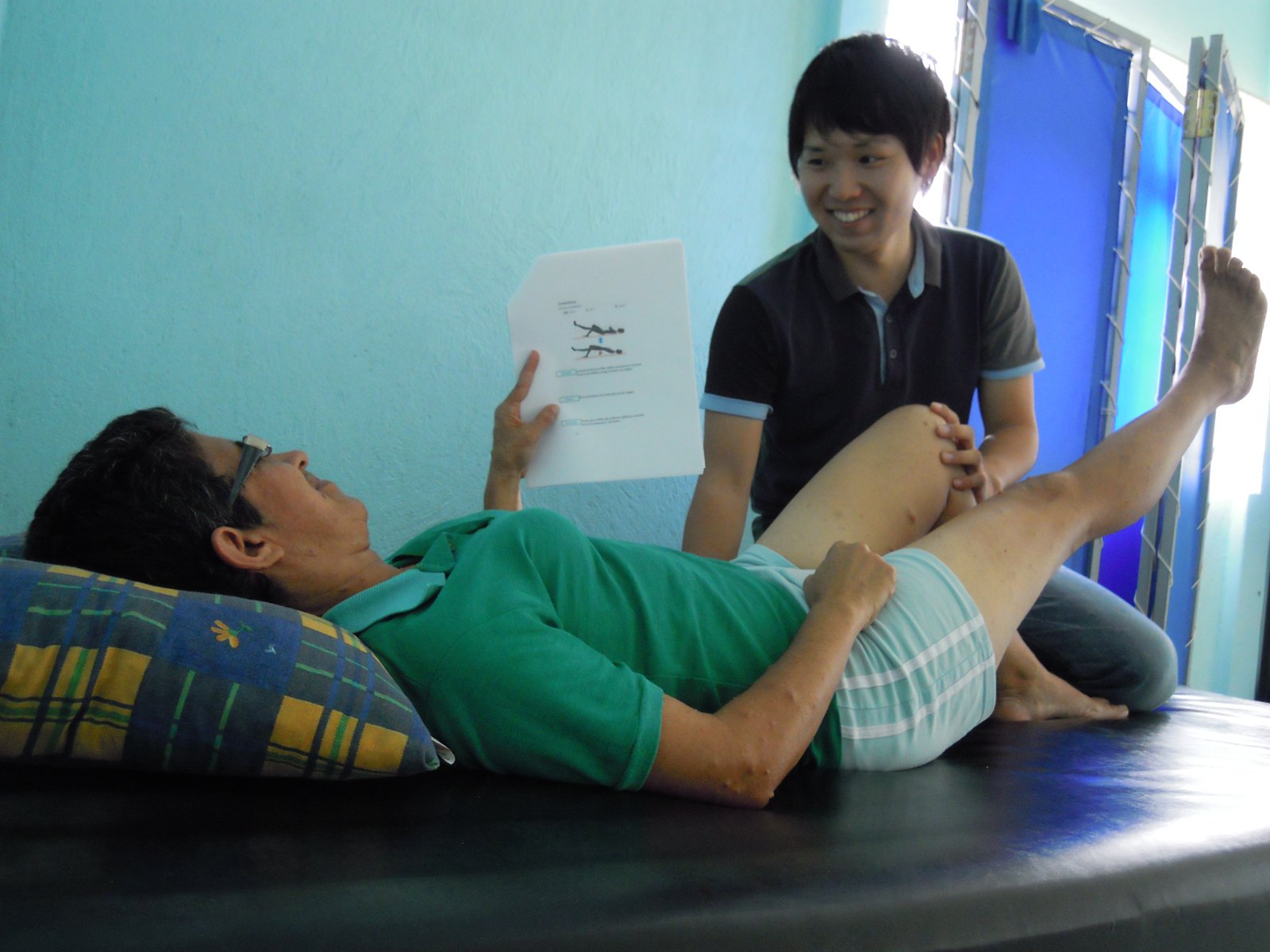
The clinic in the Indigenous Ngäbe village (Costa Rica Stories #4) had a single waist-high treatment table, and that was it. There we did pediatric rehab, treated back pain in the elderly, and followed up fractures. So on the ground, making do with whatever was there became a daily habit.
For instance, for a patient with paralysis in both legs of unknown cause, with a protruding tailbone and a pressure ulcer on the right heel, I made a pressure-relief cushion almost for free (thanks to information from a senior physiotherapist who had worked in Thailand). Afterward it curbed the inward twisting of the right leg, protected the heel ulcer, and let the back of the thighs distribute the body's weight. At the bedside I also put up a positioning chart for the nursing-home staff. Once the chart was up, the staff started cooperating — and nothing made me happier.
For patients with no brace, I sometimes started gait practice by combining an off-the-shelf knee brace with an elastic bandage to substitute for ankle support. As for the braces themselves, I've written about that in "Where My Research Began: Hand-Building a Brace in Costa Rica (Costa Rica Stories #8)."
Physiotherapy Within the System — CCSS, CNREE, and Centralization
Costa Rica's public healthcare is run by CCSS (the Costa Rican Social Security Fund), and rehabilitation and disability welfare were then handled with the involvement of CNREE (as noted, CNREE was reorganized into CONAPDIS in 2015).
When I first arrived, I couldn't quite pin down the official name of the local rehab site I worked at, so I just kept calling it "Casa de rehabilitación (the house of rehabilitation)." A year and a half later, "casa de rehabilitación" started appearing even in CNREE's own descriptions, and before I knew it my colleagues and patients were using the term too. Maybe it isn't the name on the sign but what actually happens in a place that decides what it gets called.
Working out in the provinces, what I felt keenly was how far off the decentralization of rehabilitation care was. In the capital, San José, sits the National Rehabilitation Center, CENARE (Costa Rica Stories #11), where brace fabrication is also concentrated. Behind the eight months it took a rural patient to receive a single brace lies exactly this over-concentration. In the latter half of my posting, I paired up with a physiotherapist at the San Vito hospital and started seeing patients together in the evenings after regular work — hoping that if efficiency rose even a little, decentralization might inch forward, even ever so slightly.
And Yet, Why I Could Still Believe
Costa Rican physiotherapy ran by a different yardstick from Japan's — in education, in systems, in equipment. There were moments I thought, "how, with people this dedicated," and moments I was bewildered, "why to this extent." Both were real.
But when I met a driven colleague, layered on improvisations with whatever was at hand, and saw a patient glad in the end — I could believe that what lies at the core of physiotherapy is the same, whatever the country. The "other shape of physiotherapy" I saw over those two years became the very lens of my later research on assistive devices and disability policy.
Not the equipment, not the system, but keeping on asking what you can do for the person in front of you. The core of physiotherapy was the same, whatever the country.
Further reading
- Caja Costarricense de Seguro Social (CCSS — Costa Rica's social security fund)
- CONAPDIS (National Council for Persons with Disabilities; formerly CNREE)
- JICA Volunteers (official)
- Where My Research Began: Hand-Building a Brace in Costa Rica (Costa Rica Stories #8)
- The Day I Visited CENARE, Costa Rica's National Rehabilitation Center (Costa Rica Stories #11)