The morning after walking the quiet ruins of Uxmal, I caught the first morning ADO bus from Mérida's CAME terminal and rode roughly two hours east across the Yucatán Peninsula. The destination was Chichén Itzá: a UNESCO World Heritage Site (inscribed in 1988) and one of the New Seven Wonders of the World (selected in 2007), the largest urban center of the Late-Postclassic Maya.
The name means "at the mouth of the well of the Itzá" in Maya. On the dry limestone plateau of the inland peninsula, two large cenotes (natural sinkhole wells) provided the water that made it possible to build a city here from the 9th to the 13th century. Just as Uxmal's Puuc-zone cities were entering decline, Chichén Itzá rose to take over as the next regional capital, drawing in influences from the Toltec north. Compared to the refined Puuc style I had seen the day before, this was a city of an entirely different character — large-scale, militaristic, imperial.
El Castillo (the Temple of Kukulcán) — a pyramid that is also a calendar
Step through the main entrance and the first monument you face is the Temple of Kukulcán, better known as El Castillo. About 24 m of stepped platform plus a temple at the top brings the total height to roughly 30 m, with a square base 55 m on a side. It is the icon of Chichén Itzá and the building that earned the site its place among the New Seven Wonders.
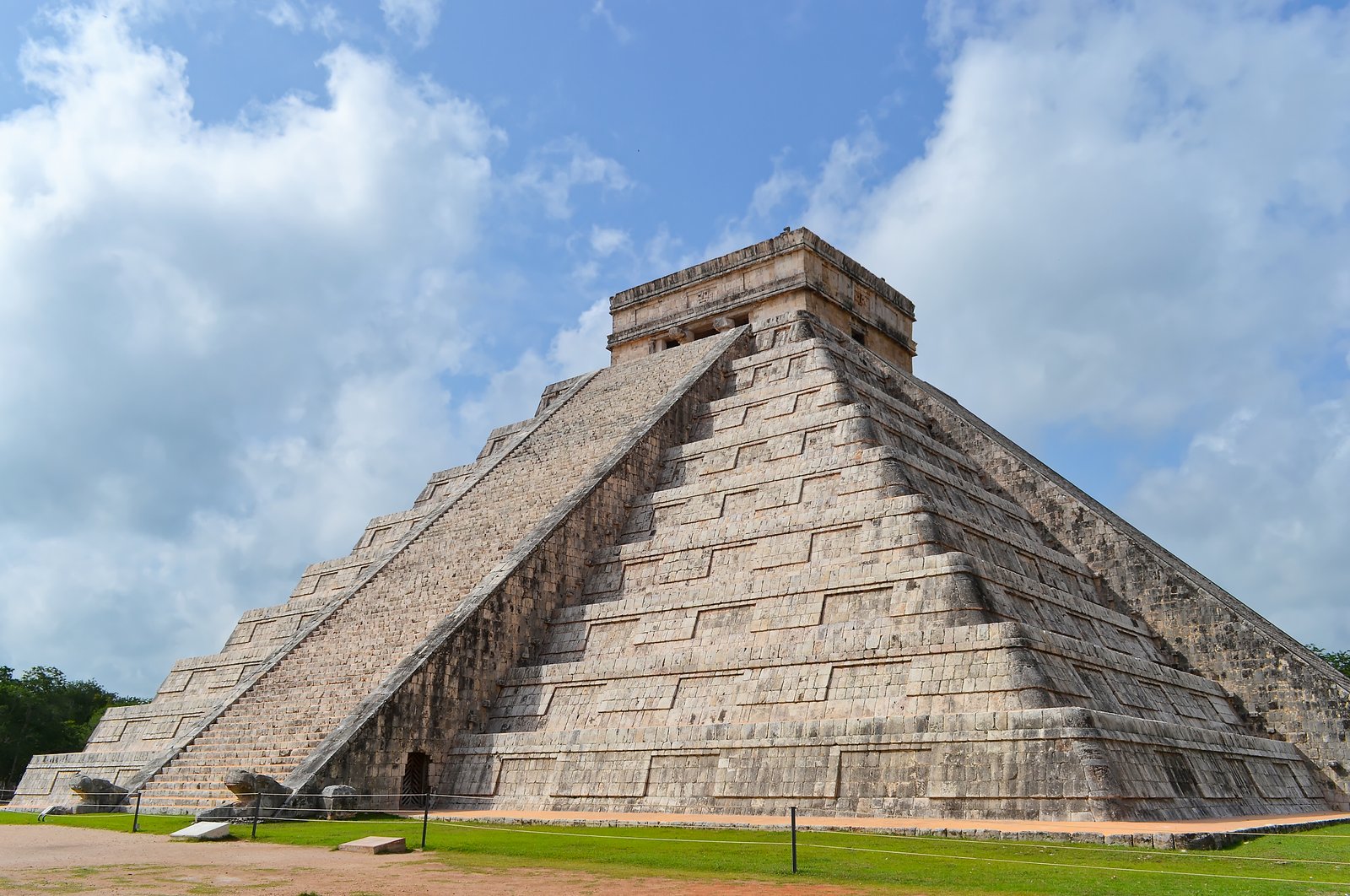
What makes the building extraordinary is that its very geometry encodes the Maya calendar. Each of the four staircases has 91 steps; together with the temple platform on top, the total comes to 365 — one solar year. The nine platforms are split visually by the central staircases, giving 18 panels per side, matching the 18 months of the Maya Haab calendar, and the recessed decorative panels on each face count 52 — the length of the Calendar Round (see Encyclopædia Britannica — El Castillo).
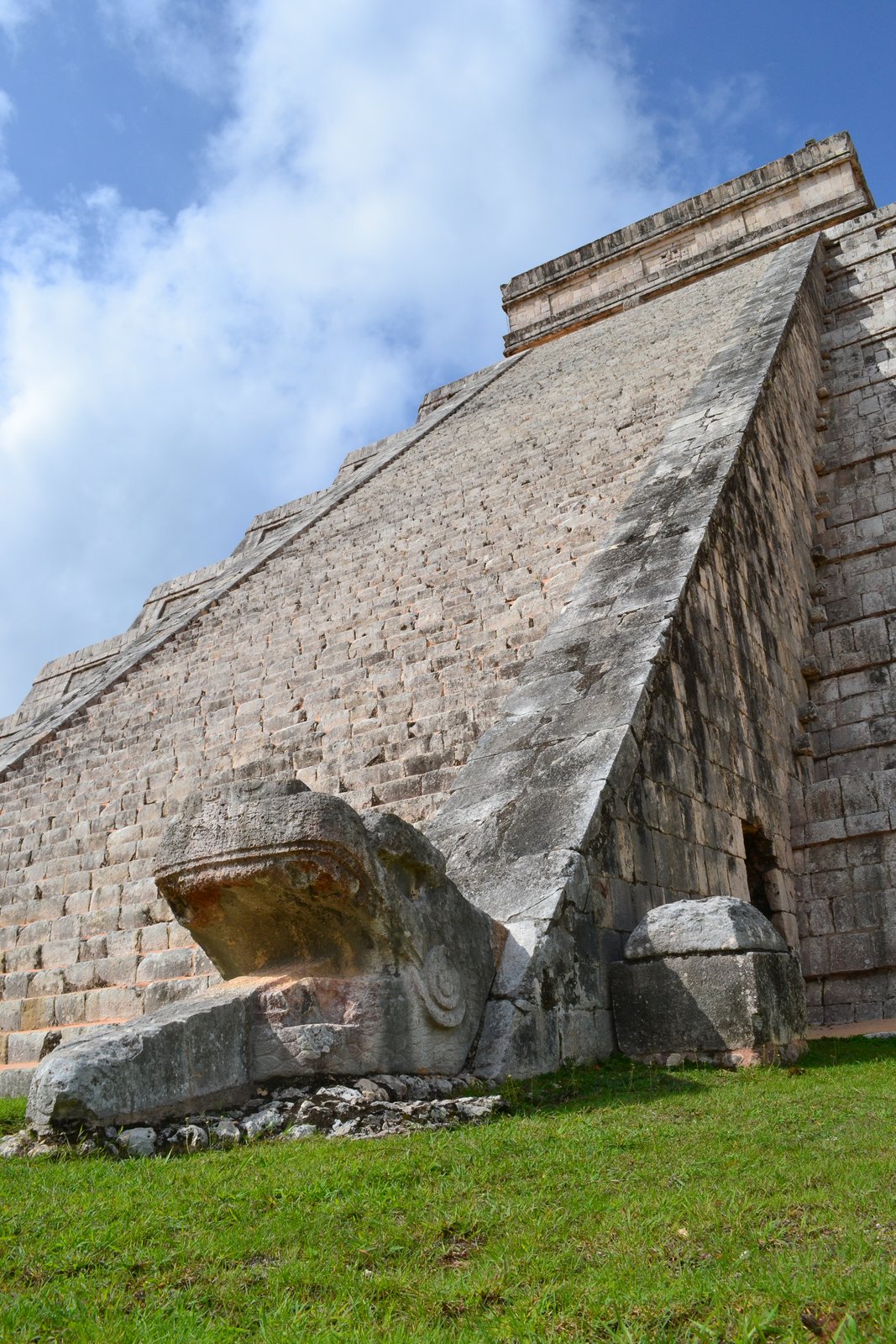
The famous equinox shadow phenomenon is part of the same design. Twice a year, when the sun rises due east and sets due west, the staggered platforms cast a rippling triangular shadow down the northwestern balustrade of the staircase that connects with the carved serpent head at its base — the descent of Kukulkan. Maya astronomy and architecture were fused into a single working device, a point Anthony Aveni made central in Skywatchers of Ancient Mexico (University of Texas Press, 1980).
Visitors can no longer climb the pyramid (closed to ascent since 2006). Even from below, however, knowing that the building was built to be a working clock and not just a temple completely changes how it looks.
The Temple of the Warriors and the Group of a Thousand Columns
Cross the plaza northeast of El Castillo and you arrive at the Templo de los Guerreros (Temple of the Warriors) and the colonnaded Grupo de las Mil Columnas (Group of a Thousand Columns) that fronts it.
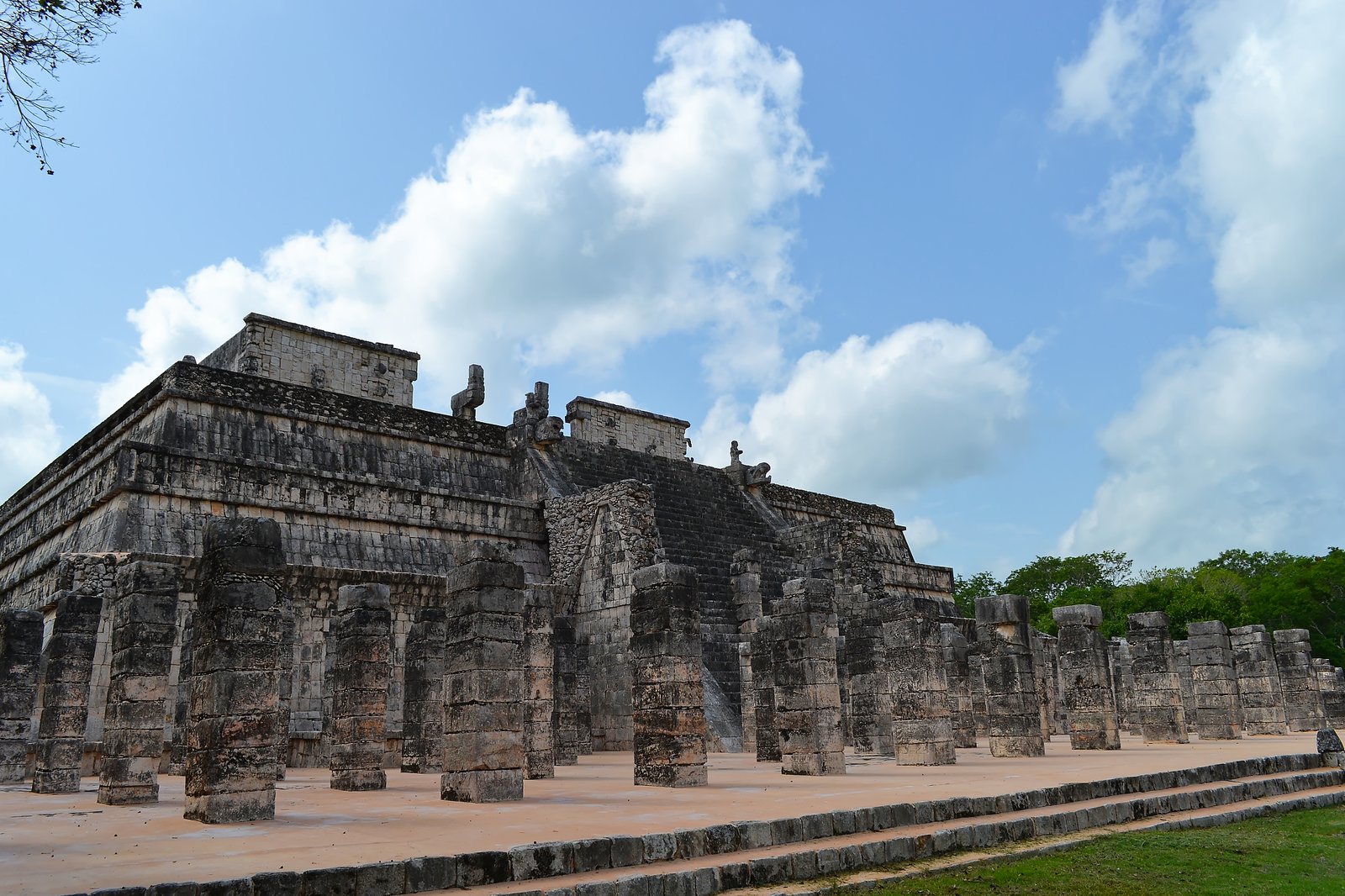
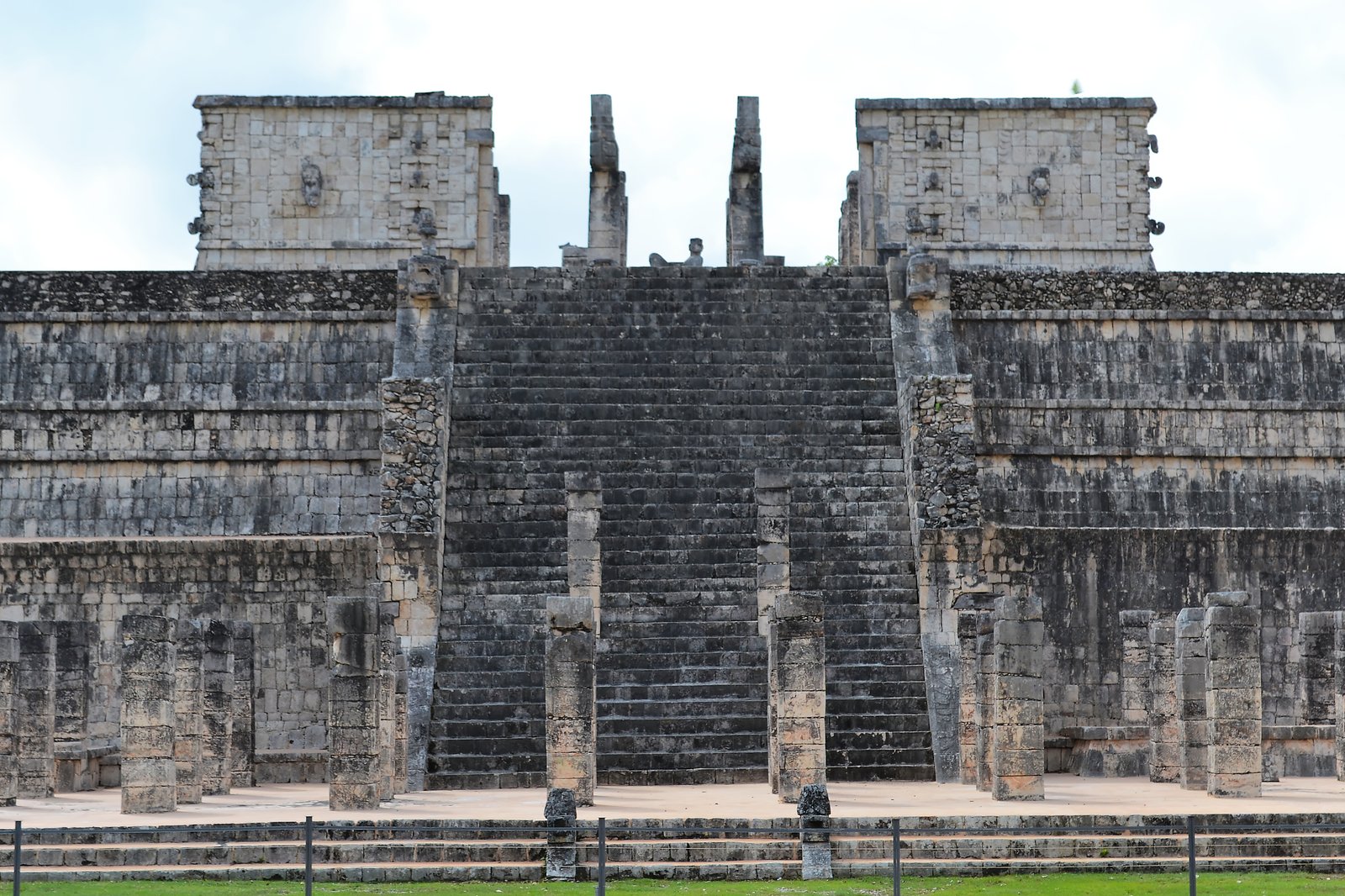
The Temple of the Warriors stands on four stacked platforms, with carved reliefs of warrior processions, captives, and eagle-and-jaguar emblems on the columns and inner walls. Stylistically, the building is strikingly similar to Toltec architecture at Tula on the central Mexican plateau. The traditional view holds that this reflects direct Toltec influence at Postclassic Chichén Itzá, while more recent work treats the resemblance as the product of long-distance exchange and shared ideology rather than migration (see INAH — Zona Arqueológica de Chichén Itzá).
The Group of a Thousand Columns spreads in front of and to the south of the temple — a vast forest of stone columns. Several hundred in number, the orderly grid is overwhelming, and no other Maya site has anything quite like a hypostyle plaza on this scale. It is interpreted as a market, ceremonial space, and venue for public assembly.
The Great Ball Court — the largest in Mesoamerica
Just northwest of El Castillo, set slightly apart from the main complex, lies the Gran Juego de Pelota — at roughly 168 m long and 70 m wide, the largest ball court anywhere in Mesoamerica. The walls along each side stand more than 8 m high.
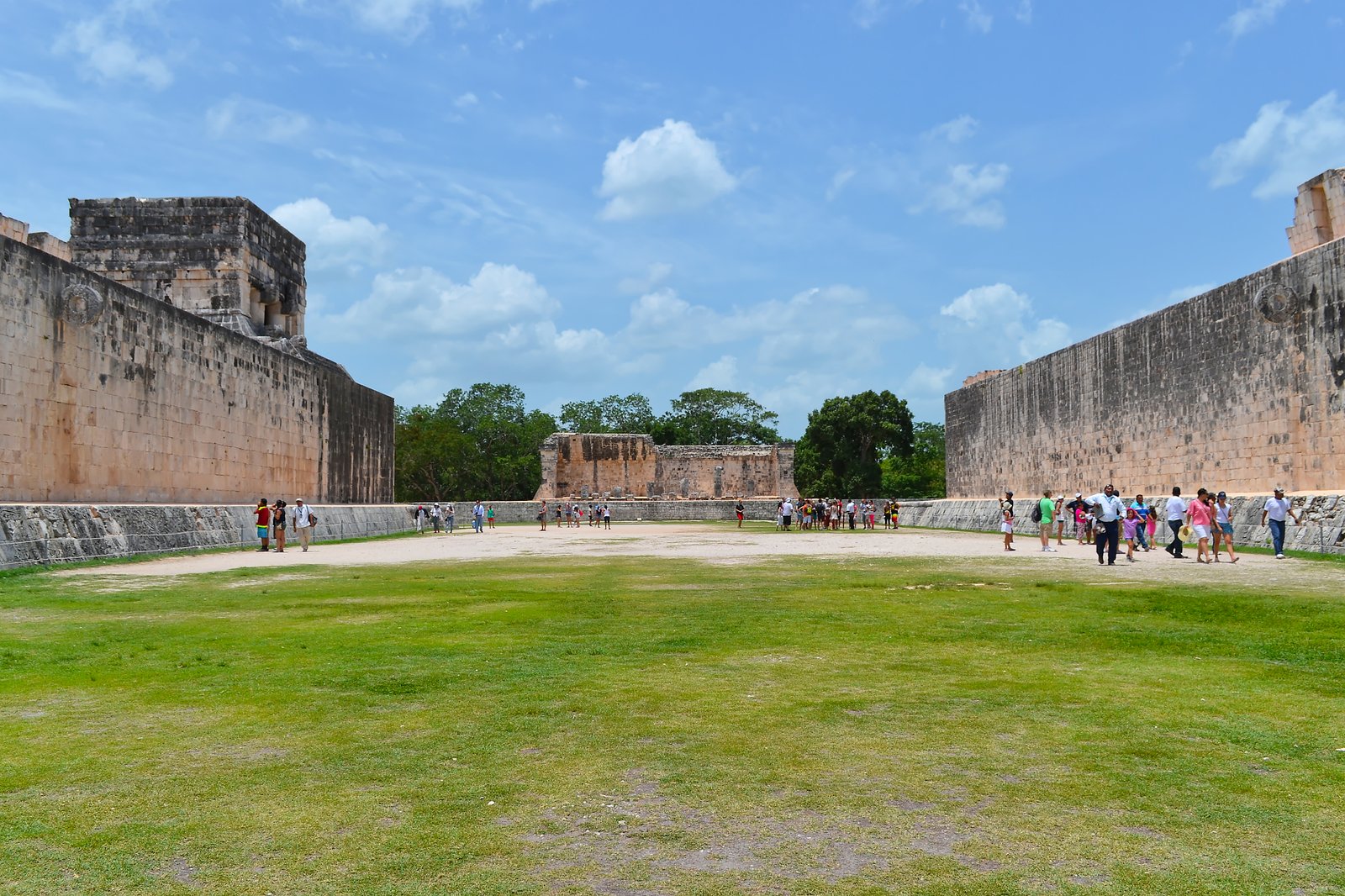
The ball game (pok-ta-pok / ulama) was played all over Mesoamerica, with players striking a heavy rubber ball with their hips or elbows and trying to drive it through stone rings mounted high on the walls. At Chichén Itzá the rings sit about 6 m off the ground — actually scoring would have been remarkably difficult. The game carried strong religious meaning, and the question of whether the losers (or the winners) were sacrificed is still debated. Reliefs along the side walls do show beheaded players whose necks sprout serpents in place of jets of blood.
The Sacred Cenote — the well that received offerings
From north of El Castillo, an ancient ceremonial road called a sacbé ("white road") runs about 300 m through the forest to the Cenote Sagrado — a near-circular natural well, roughly 60 m across, with a 27 m drop to the water surface.
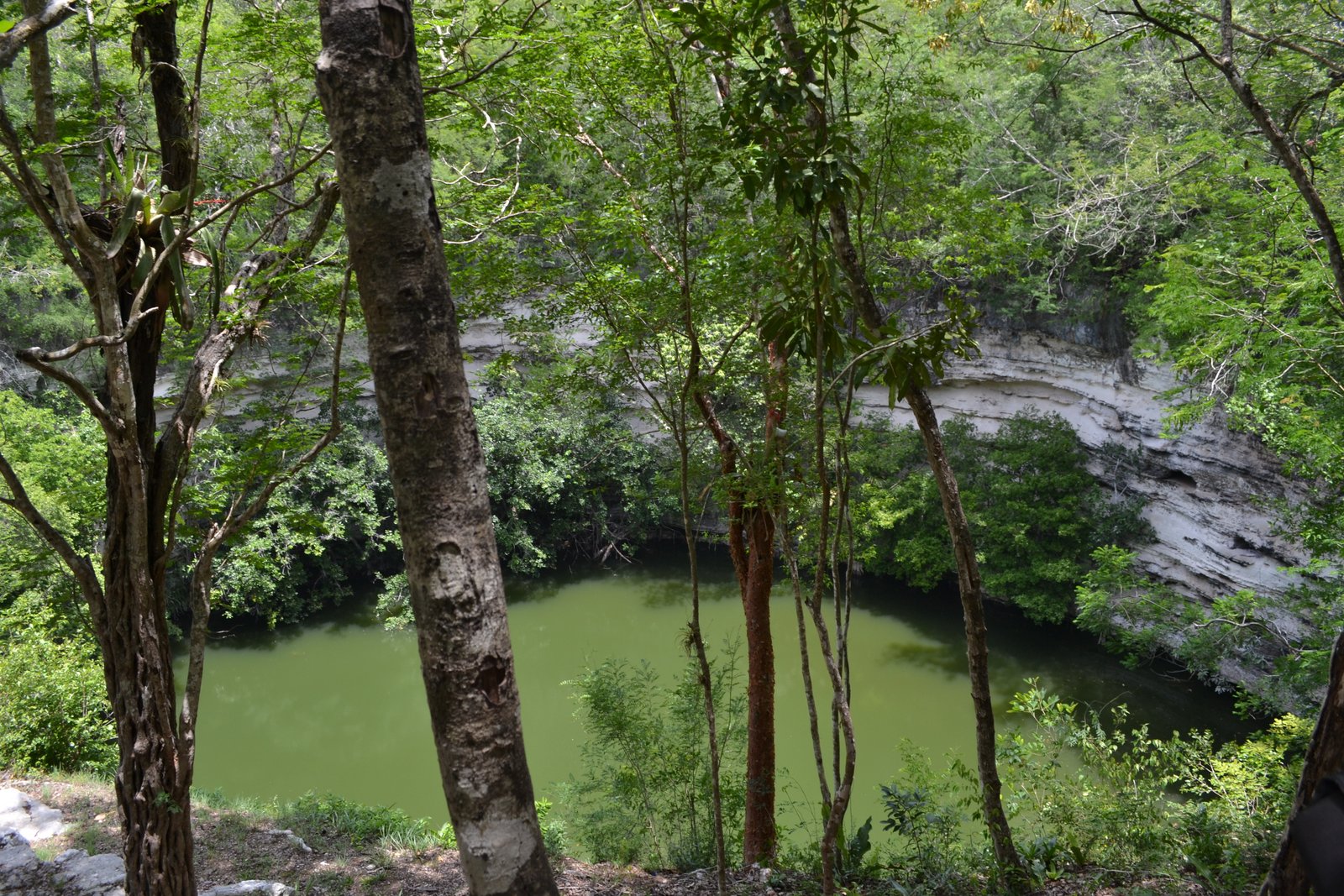
This was not a drinking-water source but a purely ritual site. Dredging carried out by Edward Herbert Thompson in 1904–1910, and later joint work by INAH and the National Geographic Society, recovered large quantities of human bone, jade, gold, copper, wood carvings, rubber, and incense vessels from the bottom of the well (see Encyclopædia Britannica — Chichén Itzá). The 16th-century account of Yucatán Before and After the Conquest by the Spanish bishop Diego de Landa, which describes human sacrifices being thrown into the cenote during droughts and epidemics as offerings to the rain god Chaac, broadly aligns with the archaeological evidence.
Even leaning over the railing, the deep-green surface barely moved. Only the cicadas in the surrounding jungle made any sound. After reading the records of what happened here, the place stops feeling like a tourist stop entirely.
A commercialized ruin — Chichén Itzá as a tourist destination
The single biggest difference between Chichén Itzá and Uxmal, walking through it on the same trip, was the sheer volume of people and souvenir vendors.
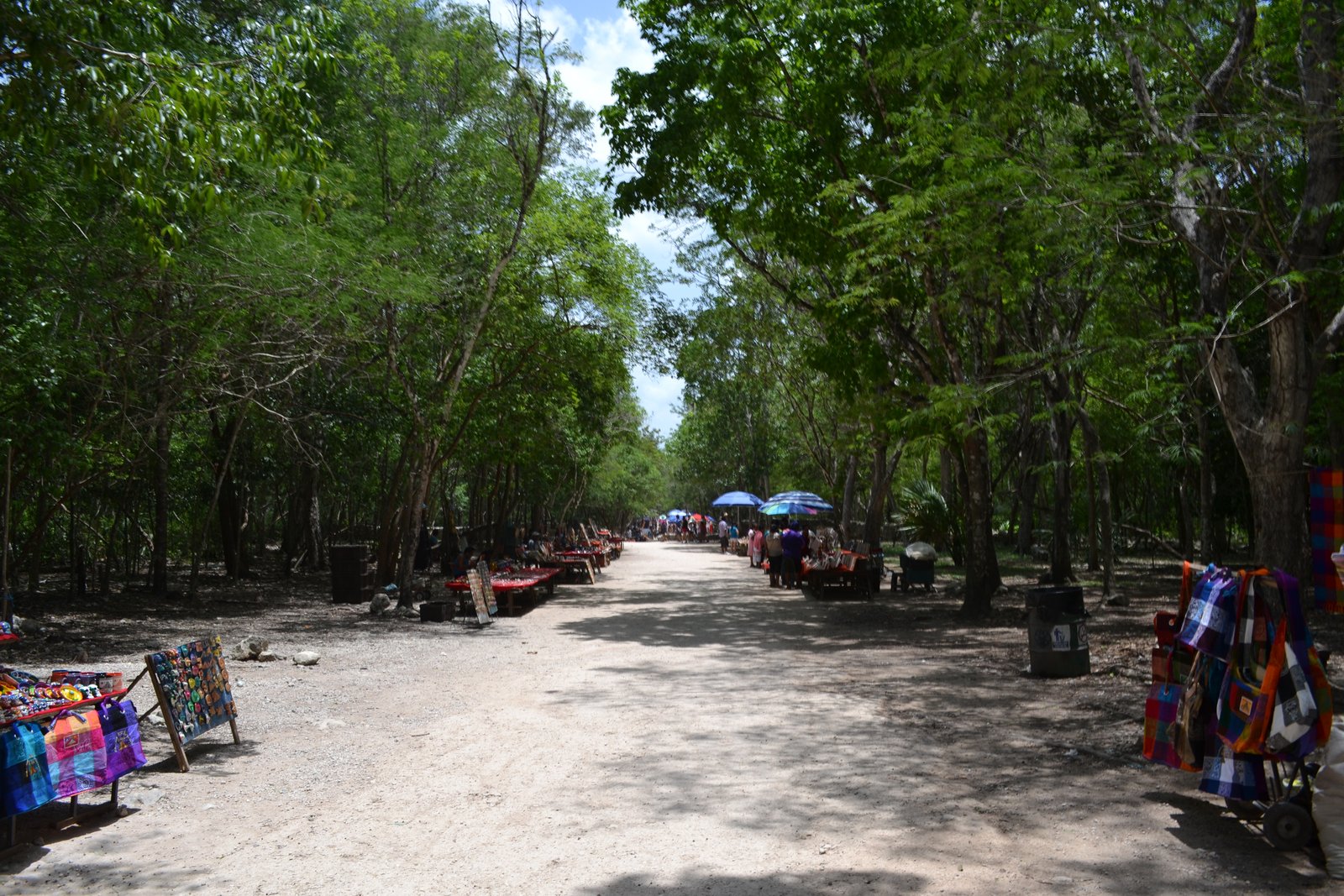
Most of the major paths inside the archaeological zone are flanked by an unbroken line of vendor stalls. Where Uxmal had felt sparse and quiet, Chichén Itzá is constantly crowded with day-trip groups arriving from Cancún and Playa del Carmen, and the calls of guides, money changers, and stall keepers fill the site like a small market grafted onto the ruin.
After Chichén Itzá was named one of the New Seven Wonders in 2007, visitor numbers rose sharply, and INAH has since introduced restrictions to protect the monuments — closing El Castillo to climbers, limiting access to older structures, and gradually raising entrance fees. Of all the Maya sites, this is the one where the tension between tourism and conservation is most visible, and it cannot honestly be described without that.
If Uxmal is the quiet completion of Puuc style, Chichén Itzá shows what came next — a militarized, imperial, mass-mobilizing version of the same Maya world. A 365-step pyramid, a well that swallowed offerings, an unbroken row of vendors.
Half a day inside the Late-Postclassic Maya turned out to be a strange double exposure of past and present, with the ancient capital and the modern tourist destination both clearly visible at once.
Places visited
Travel guide
※ This section is editor-supplied background based on public information. Confirm fares and hours with the official sources before traveling.
Access
- From Mérida: ADO bus from the CAME terminal, about 2 hours. The earliest morning departures (around 6:30–8:00) avoid both the heat and the crowd
- From Cancún / Playa del Carmen: ADO bus, 3–4 hours. A wide range of day tours run from both
- From Valladolid: the closest base. About 45 minutes by colectivo or local bus. A good option for a quieter afternoon visit
- By rental car: roughly 2 hours via Highway 180, or 1.5 hours on the 180D toll road, from Mérida
- Entrance: Two-part fee — federal (INAH) plus state (CULTUR), about MX$700 total in 2024. The Luz y Sonido evening sound-and-light show is ticketed separately
- Hours: 8:00–17:00 (last entry 16:00). Arriving right at opening is by far the most comfortable for both crowds and heat
Nearby places worth a stop
- Cenote Ik Kil — a swimmable cenote about 5 minutes by car. Many tours include it
- Historic Valladolid — designated a Pueblo Mágico. About 45 minutes by car
- Ek Balam — a quieter Maya site, known for the well-preserved stucco sculpture on its Acropolis
- Izamal — the "Yellow City," with both colonial monastery and Maya ruins inside the same town
References
- UNESCO World Heritage Centre — Pre-Hispanic City of Chichen-Itza
- INAH (National Institute of Anthropology and History) — Zona Arqueológica de Chichén Itzá
- Encyclopædia Britannica — Chichén Itzá
- Encyclopædia Britannica — El Castillo
- Yucatán State Tourism Board — Zona Arqueológica de Chichén Itzá
- New 7 Wonders of the World — Chichén Itzá
- Anthony F. Aveni, Skywatchers of Ancient Mexico (University of Texas Press, 1980) — archaeoastronomical interpretation of the equinox phenomenon
- Geoff Stray, The Mayan and Other Ancient Calendars (Wooden Books) — a concise primer on the Maya Long Count, calendar round and astronomy