On April 27, 2025, that morning, I had parked my XSR900 on the hill by Ishinomaki's Kadonowaki Elementary School and, beside the disaster ruin, listened to an older man cutting back bamboo for the storytellers. That same afternoon, I rode upriver along the Kitakami toward another disaster ruin: Ishinomaki Municipal Ōkawa Elementary School — a school close to the river's mouth, beside its embankment.
The road to Ōkawa naturally passed through the Sankaku-chitai, the triangular zone — the place the children set out toward as their evacuation site that day. A slightly raised piece of land at the foot of the Shin-Kitakami Bridge. When I had only seen the name on a map, I had pictured somewhere further inland, a refuge like a hill. But riding it for real, it was startlingly close to the Kitakami River. It was no more than a rise of ground, all but continuous with the river itself.
A school by the river
The school building of Ōkawa Elementary lay low and long across a wide schoolyard. The name post, carved "Ishinomaki Municipal Ōkawa Elementary School," still stands there.
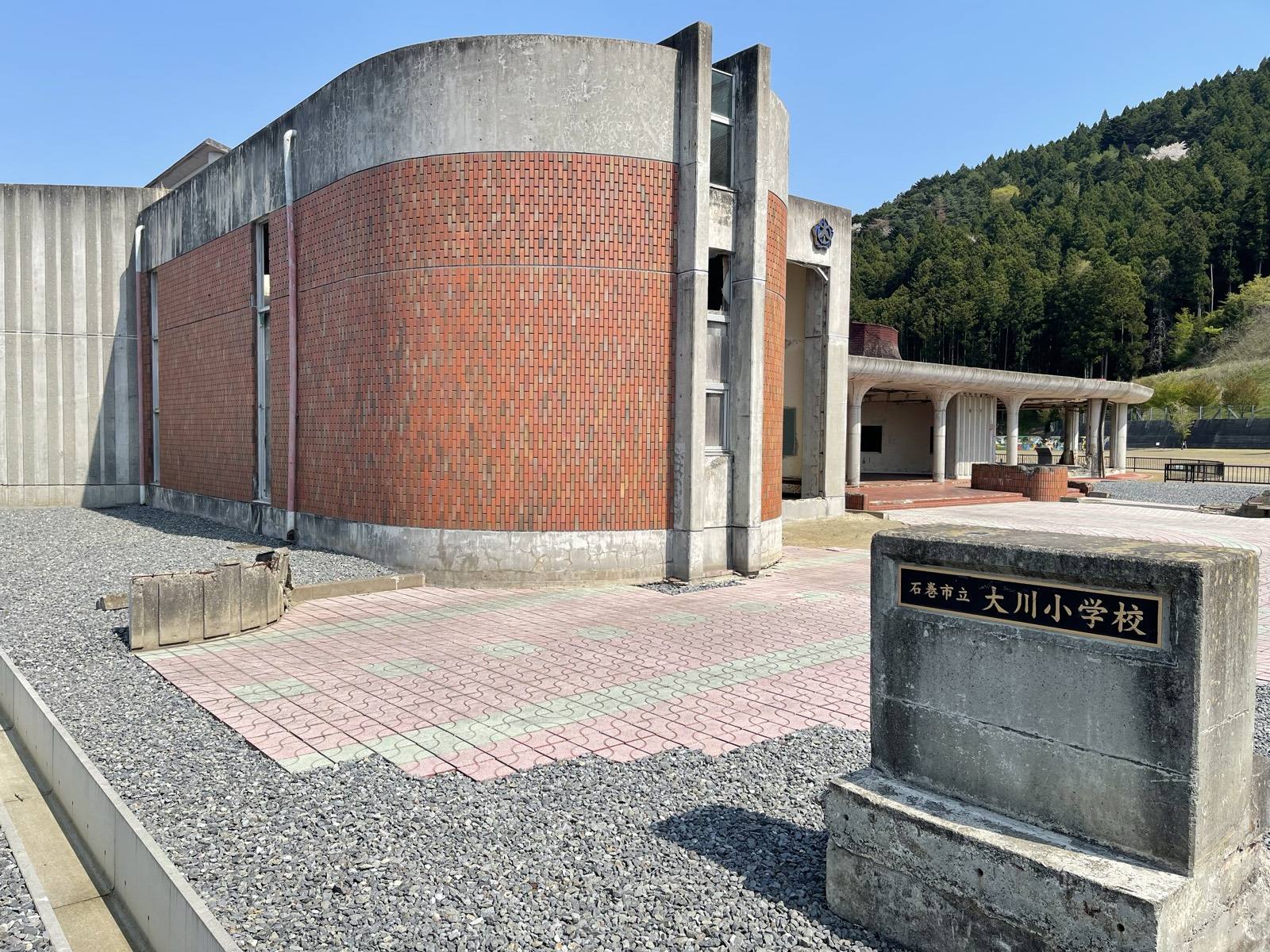
Up close, the violence of the building's ruin leaves you without words. The second-floor connecting corridor has snapped at the root and hangs down as if driven into the ground. The wall of the round building has crumbled, its rebar laid bare, its windows blackened and empty.
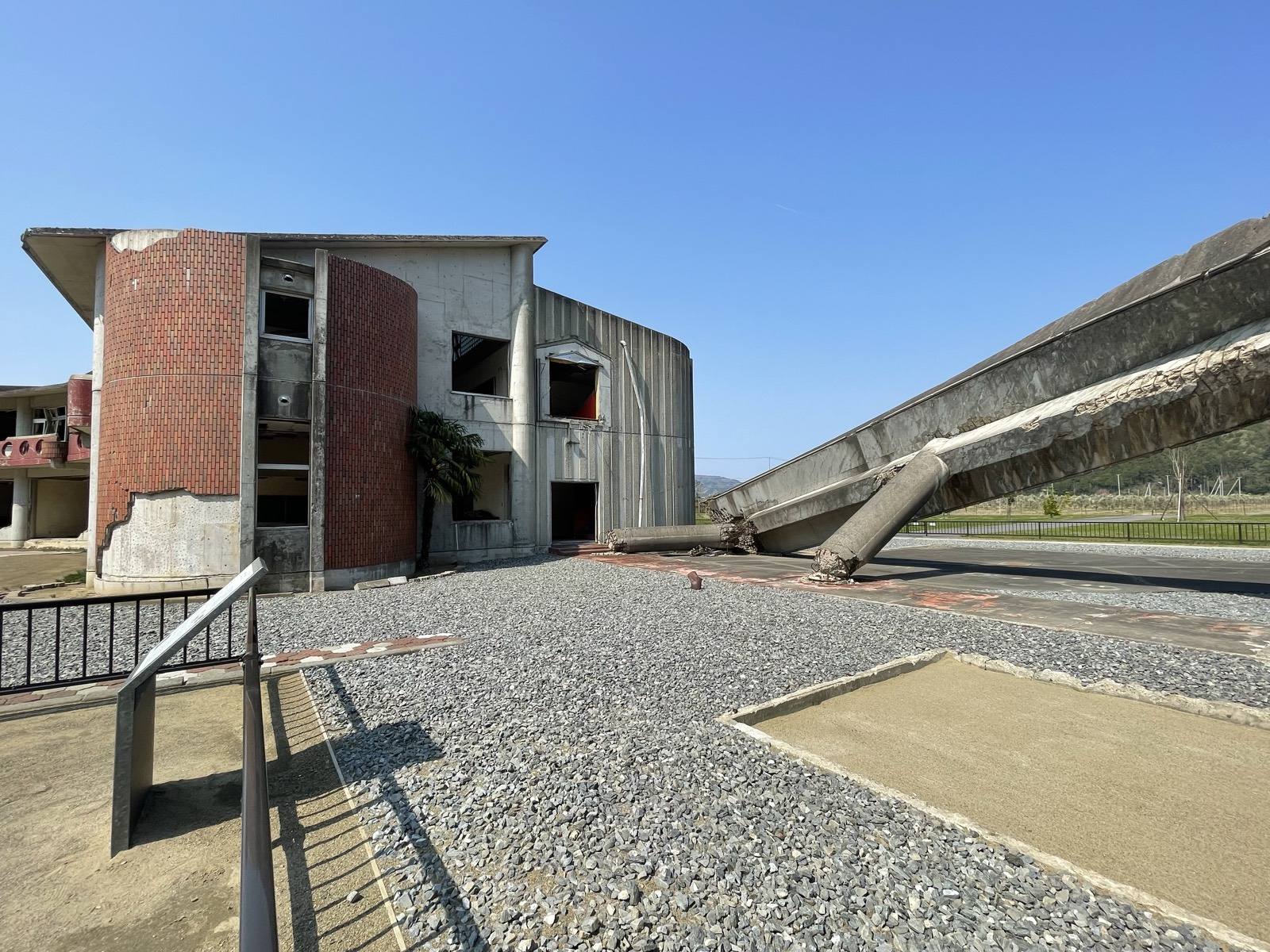
On March 11, 2011, at this school, 74 of its 108 enrolled children, and 10 of the 11 staff present that day, lost their lives to the tsunami. In front of the building, a visitor was offering incense.
The earthquake struck at 2:46 in the afternoon. The tsunami reached this school about 50 minutes later, around 3:36. Through those 50 minutes, the children waited in the schoolyard. Where to flee — the discussion went on in the yard, and at last it was decided to head for the triangular zone along the river. The line had only just begun to move when the tsunami came. To that place by the river I had ridden through a little earlier.
The words left here
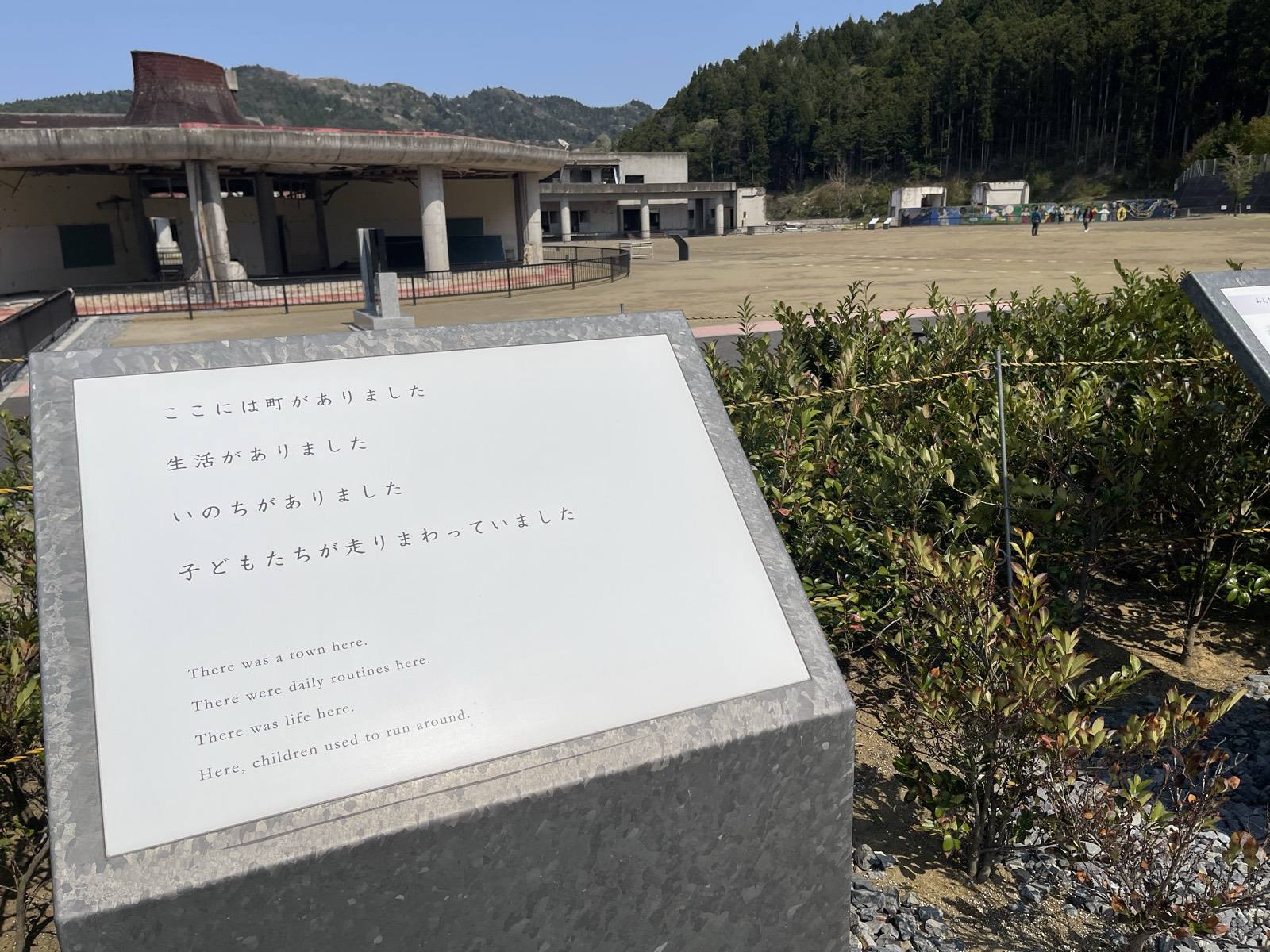
Along the edge of the schoolyard, several plaques and stone monuments are set. On one of them, this was inscribed.
There was a town here. There were daily routines here. There was life here. Here, children used to run around.
Just in front of the collapsed building, before the wall lined with round windows, there was another plaque.
March 11, 2011 —
It was a morning like any other.
On that day, we saw them off after telling each other "Have a nice day."
How we wish we could hold them in warm arms and say, "It was cold, wasn't it?"
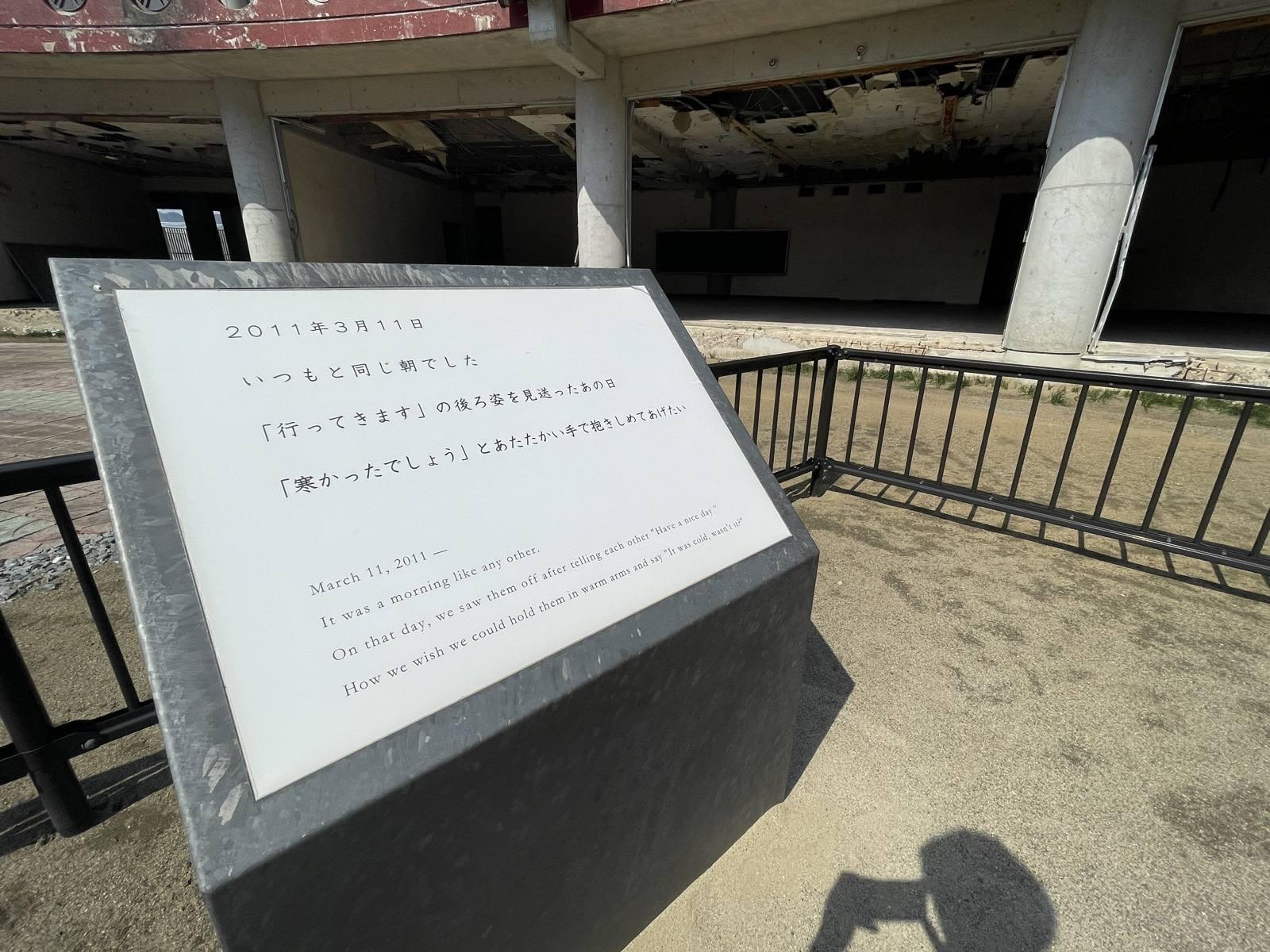
— A morning like any other. Before that one line, my feet stopped. That morning, the children who came to this school left home as they always did. Saying, "I'm off." A stone monument carved with the school song stood close by, too. The whole time I was in that schoolyard, my chest was tight.
The hill they did not climb
Right behind the building is a hill — the hill the children did not climb that day. On its slope was a marker showing how high the tsunami had reached. Looking up at it, it is strikingly high. That is how vast a body of water filled this valley.
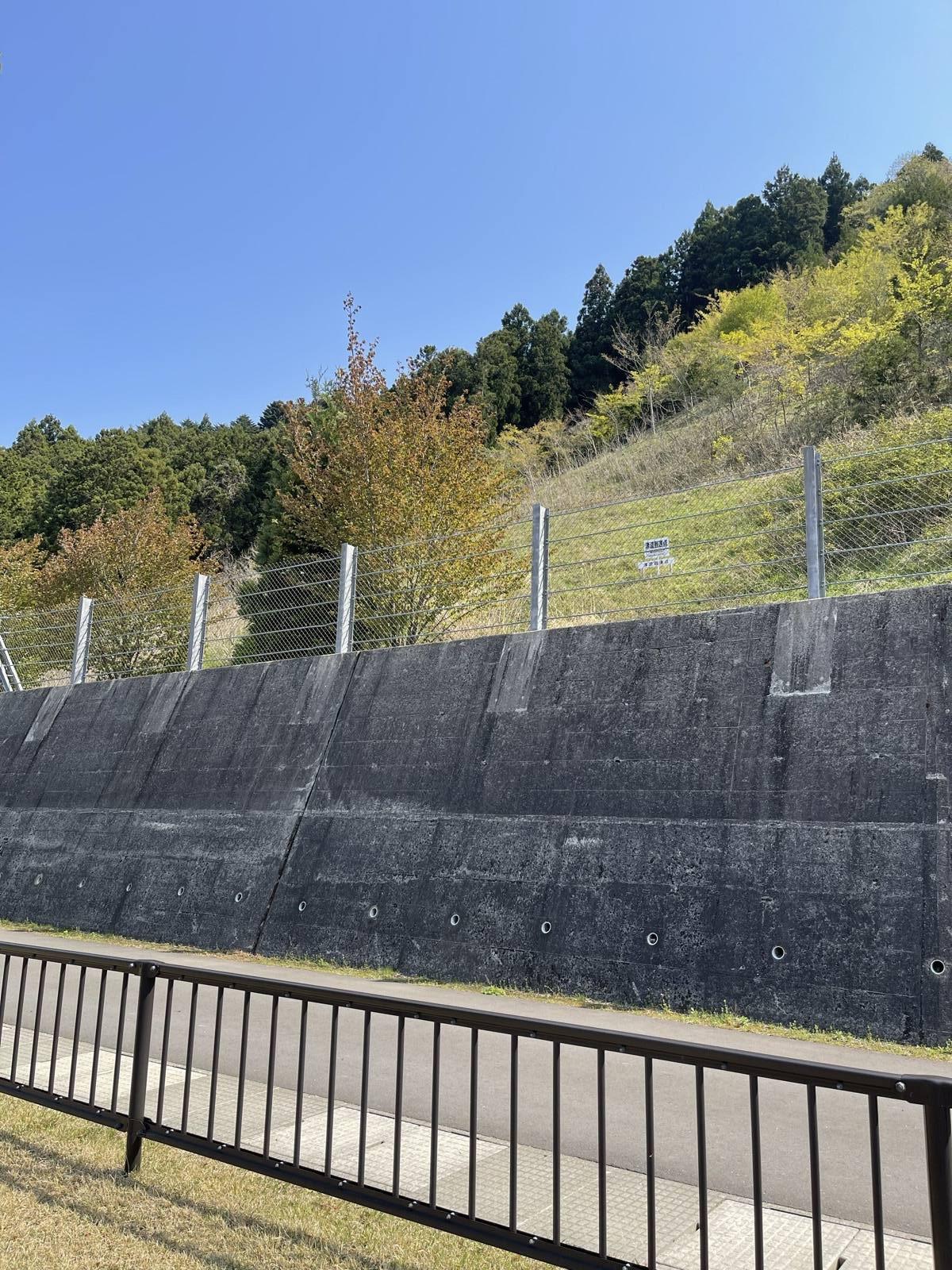
Later verification found that this back hill, too, had places that could be climbed relatively gently. But the slope I looked up at, there and then, looked steep in many places. After that great shaking, facing a tsunami that might or might not come, with young children and with elderly people who had taken refuge at the school — to decide in an instant, "everyone, up this hill." How hard that must have been. I could find no words to blame the judgment made in that moment.
On preparing beforehand
And so, I think: what should truly be asked lies not so much in those 50 minutes in the schoolyard as further back — in the "preparation," before the day ever came.
In one corner of the schoolyard stands the Ōkawa Densho Memorial, a wooden building opened in 2021. Inside, the movements of the children and staff, from the earthquake to the tsunami's arrival, were laid out panel by panel, in sequence. The lawsuit, too, was on display.
In 2018, the Sendai High Court found that the city and prefecture bore a flaw in the school's disaster-preparedness system itself. That the school's crisis-management manual had set down no specific place to flee to in a tsunami — this, the court judged an organizational failing. In 2019, the Supreme Court let the ruling stand. It was a judgment in which the courts clearly recognized a failure in a school's advance disaster prevention.
In my work with assistive devices and accessibility, I sometimes deal with disaster prevention and evacuation. Deciding the place to flee to, concretely, in advance. Writing it down on paper, and sharing it among the staff. That work — so plain in ordinary times, so easily put off — becomes, when the moment comes, the dividing line of life. Ōkawa Elementary School conveys that in a form that could not be starker.
And still, please come
As I left the memorial, a notice for a disaster-ruin guide was posted. At set times, staff would walk you through the building with commentary — so it said. But I had arrived just as those times were passing, and I could not hear it.
The Ōkawa Densho Memorial is now free to enter, open from 9 in the morning to 5 in the evening (closed Wednesdays). Staff-led commentary is suspended for the time being, and the storytellers' accounts are arranged through groups such as the Ōkawa Densho no Kai. If you visit Ōkawa Elementary School from now on, try, if you can, to go at a time when you can hear that commentary. Even in the same schoolyard, hearing first and then seeing, against only seeing — what you take away is surely different.
On the hill at Kadonowaki, the old man cutting bamboo had said, "It gets forgotten." A disaster ruin, simply standing, will one day blend into the scenery and cease to be seen. Standing in the empty schoolyard of Ōkawa Elementary School, I thought the same thing. There was a town here, there were daily routines, there was life. To hand the words of the people who carved that to whoever comes next — that, I think, is the small "preparation" a visitor can make.
Before you go
- Ōkawa Densho Memorial: open 9:00–17:00 (last entry 16:30); free admission; closed Wednesdays (the next weekday when a Wednesday is a holiday) and over the New Year period.
- Storyteller / guided commentary: staff-led commentary is currently suspended; to hear a storyteller's account, arrange it in advance through a group such as the Ōkawa Densho no Kai. Hearing the commentary before walking the grounds changes what you see.
- Getting there: Kamaya, Ishinomaki, Miyagi, near the mouth of the Kitakami River. Public transport is limited, so visiting by car is realistic (parking available).