After running through the Anthropology Museum, Guanajuato, and Teotihuacán out of Mexico City, the next stop was Palenque — a Classic-period Maya city in the Chiapas jungle, inscribed as a UNESCO World Heritage Site (1987). Going overland from Mexico City is a long haul, so I flew domestic to Villahermosa and continued by road from there. I remember staying in the small town next to the ruins and heading to the site the following morning.
Drop straight from Mexico City at 2,200 m down to lowland jungle and the air just changes. Constant high humidity, heat that sticks to your skin, the unbroken sound of birds and insects — the opposite of dry highland Teotihuacán.
Temple of the Inscriptions — the stepped pyramid that holds Pakal's tomb
Palenque's signature monument is the first thing you see when you walk in: the Temple of the Inscriptions (Templo de las Inscripciones). A stepped pyramid built up in nine tiers, with a temple at the top fronted by three doorways. It's thought to have been completed late in the 7th century.
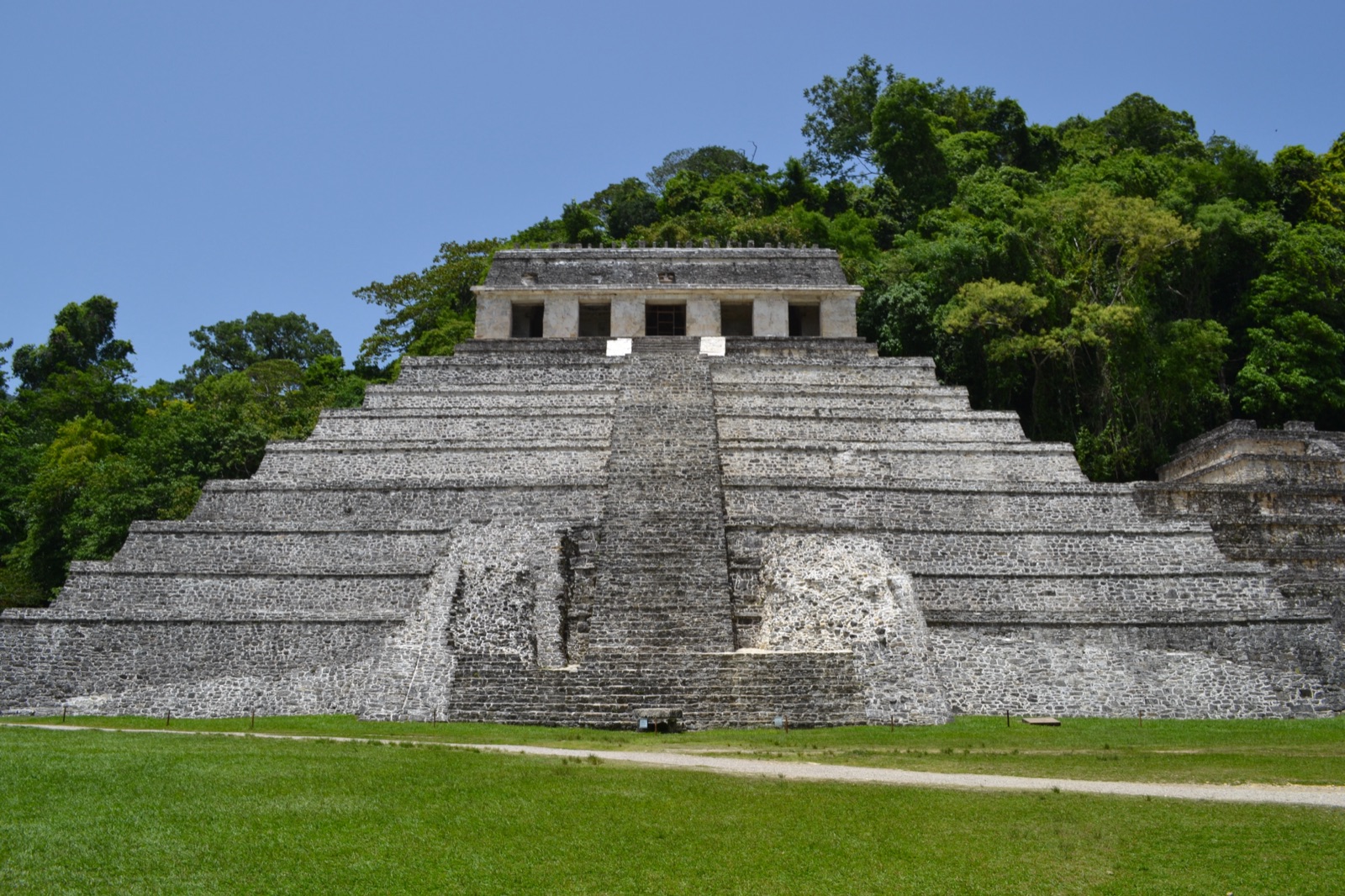
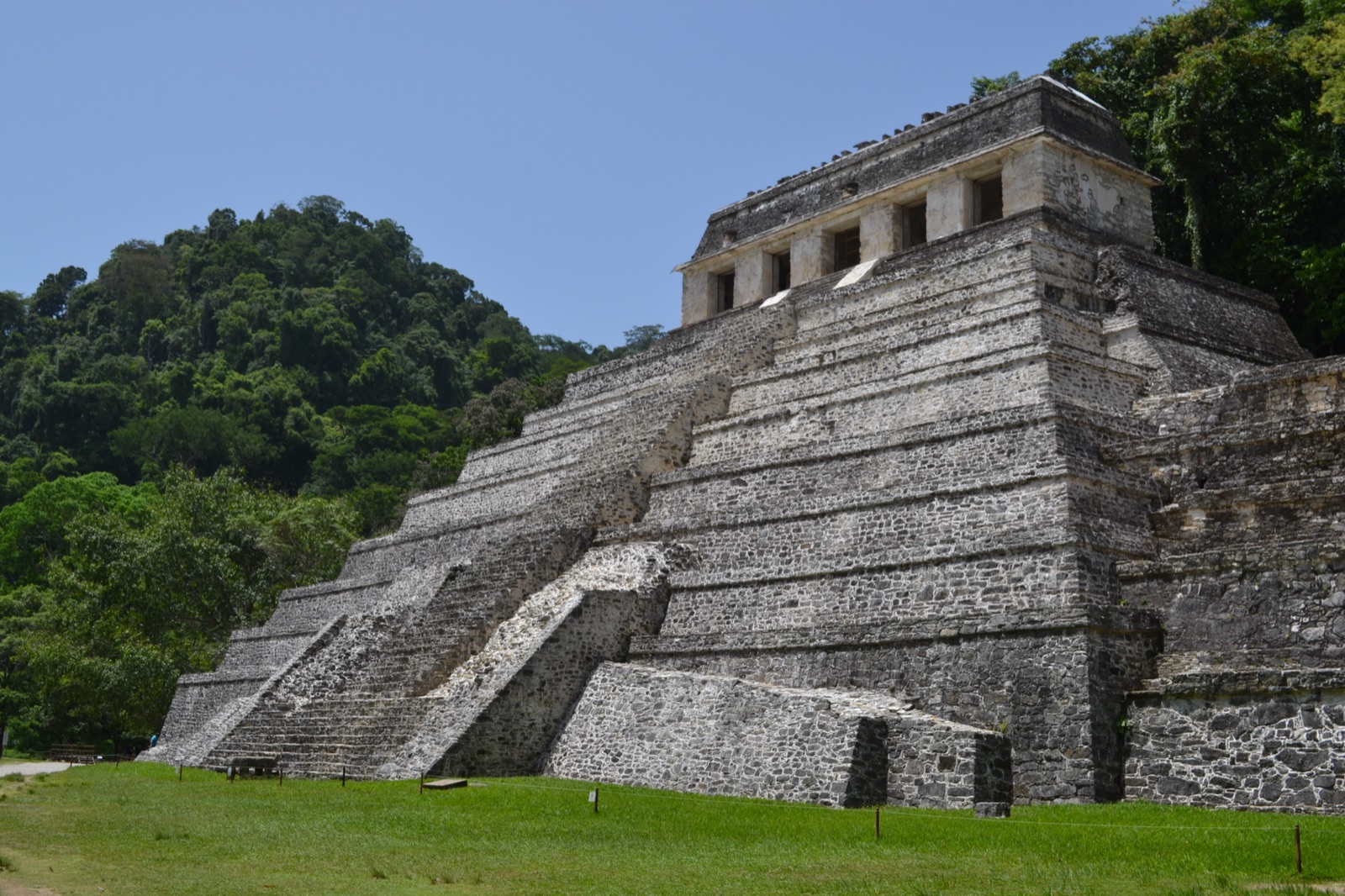
The name comes from the more than 620 Maya glyphs carved on the stone panels inside the summit temple — one of the longest Classic-period Maya inscriptions ever found, and the source from which the city's royal lineage and calendrical history were eventually deciphered. From the 1970s onward, this was the central material that Linda Schele and other scholars used to reconstruct Palenque's dynastic history, which transformed Classic Maya studies as a whole.
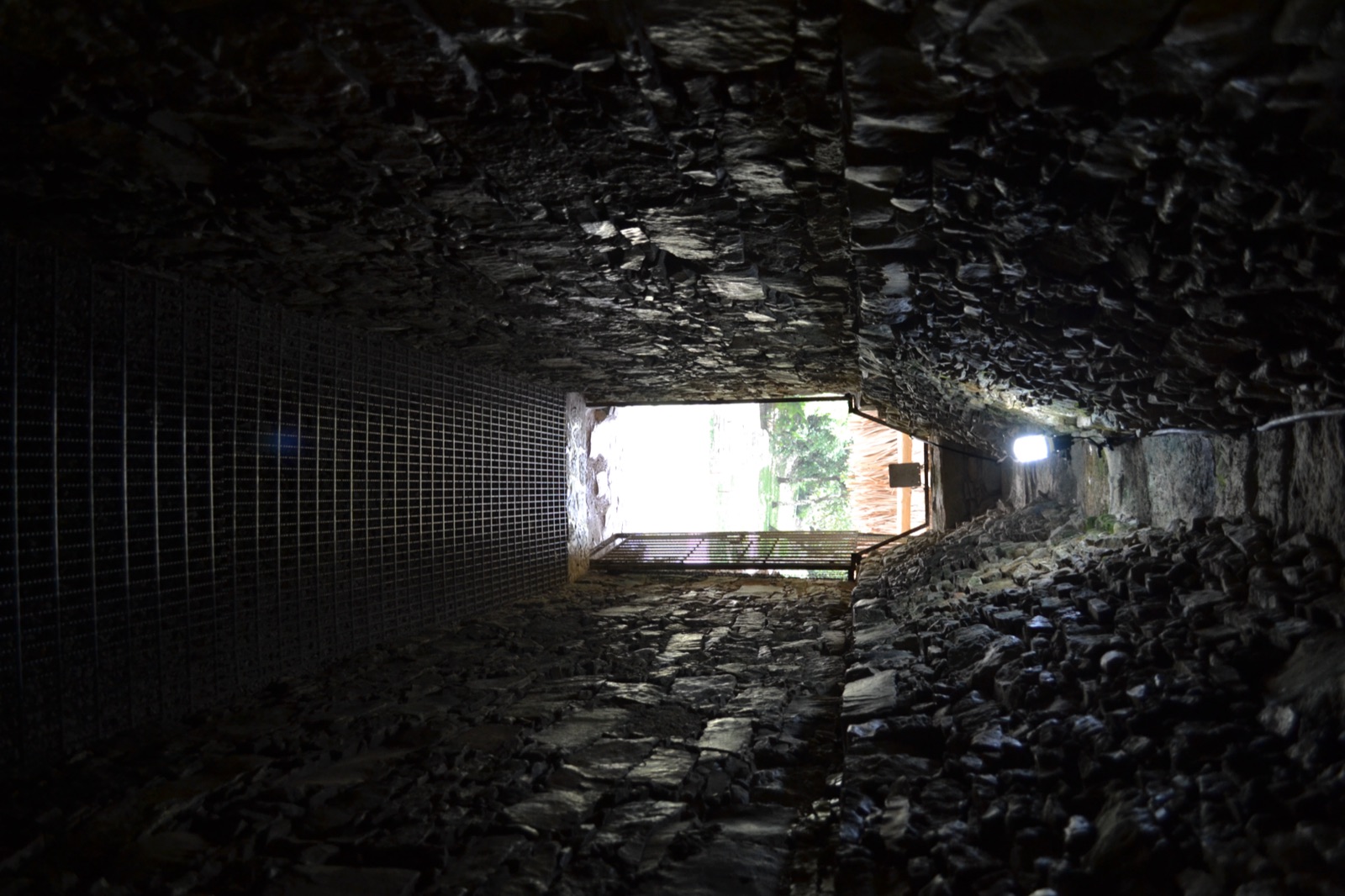
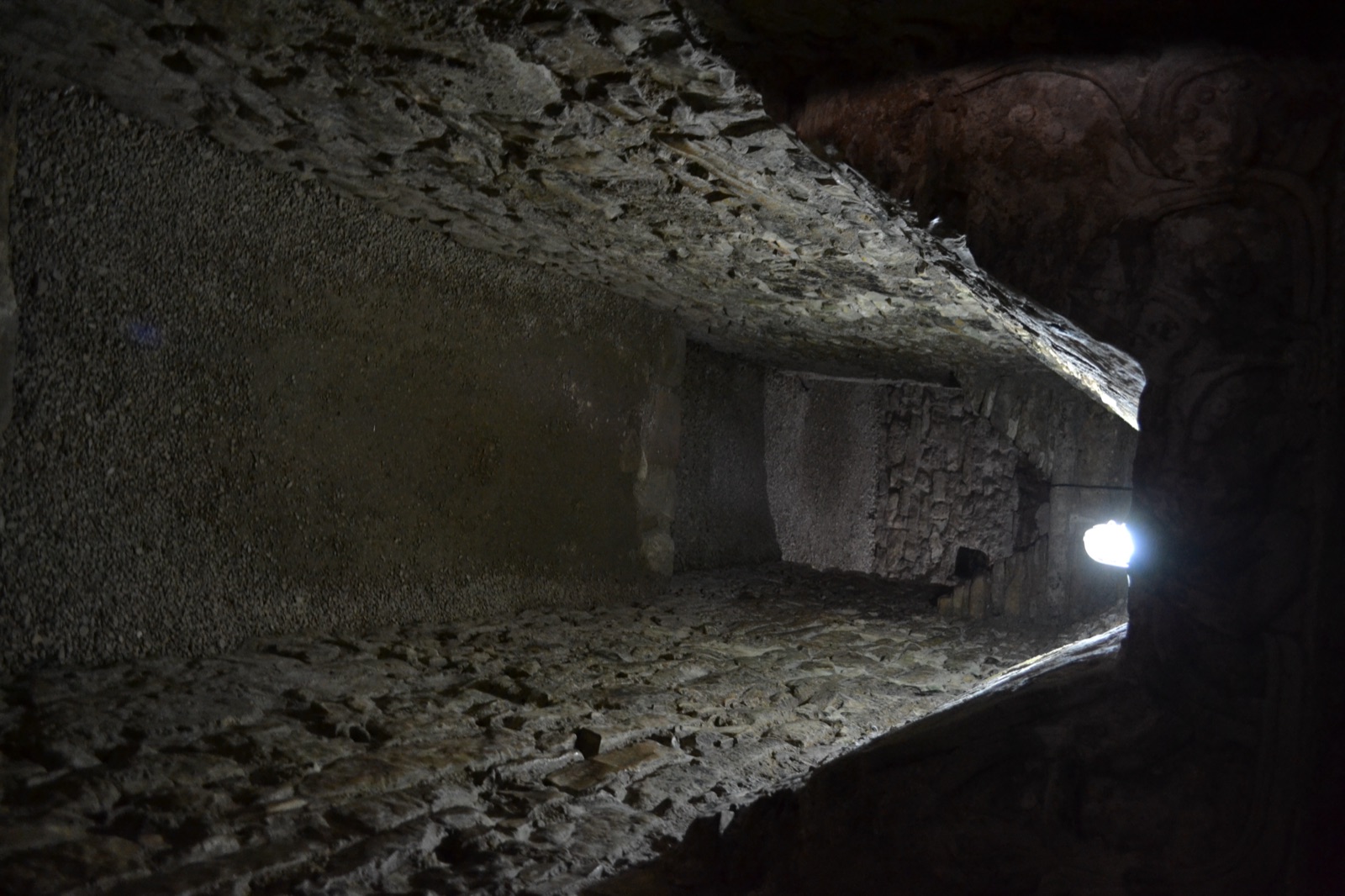
What made the temple world-famous, though, was the royal tomb that Mexican archaeologist Alberto Ruz Lhuillier discovered inside it in 1952. In 1949 Ruz noticed a suspicious hole in one of the floor stones of the summit temple. He spent four years digging his way down through a hidden, rubble-filled staircase, and finally reached the sarcophagus of K'inich Janaab' Pakal, who died in AD 683. It was the first royal burial ever confirmed inside a Maya pyramid, and it overturned the assumption of the time that "Maya pyramids are temples, not tombs" (source: Wikipedia — Alberto Ruz Lhuillier).
The relief carved on the lid of Pakal's sarcophagus is one of the best-known images of the Maya cosmos, condensing the structure of death and rebirth. The original is now at the National Museum of Anthropology in Mexico City, and the underground tomb chamber is closed for conservation. Even so, just standing on the temple itself, the weight of "that was sleeping right under here" comes through.
The Palace (El Palacio) — the observation tower and the T-shaped windows
To the north of the Temple of the Inscriptions is El Palacio, the Palace. A large multi-courtyard complex thought to be where Palenque's royal family carried out both governance and daily life.
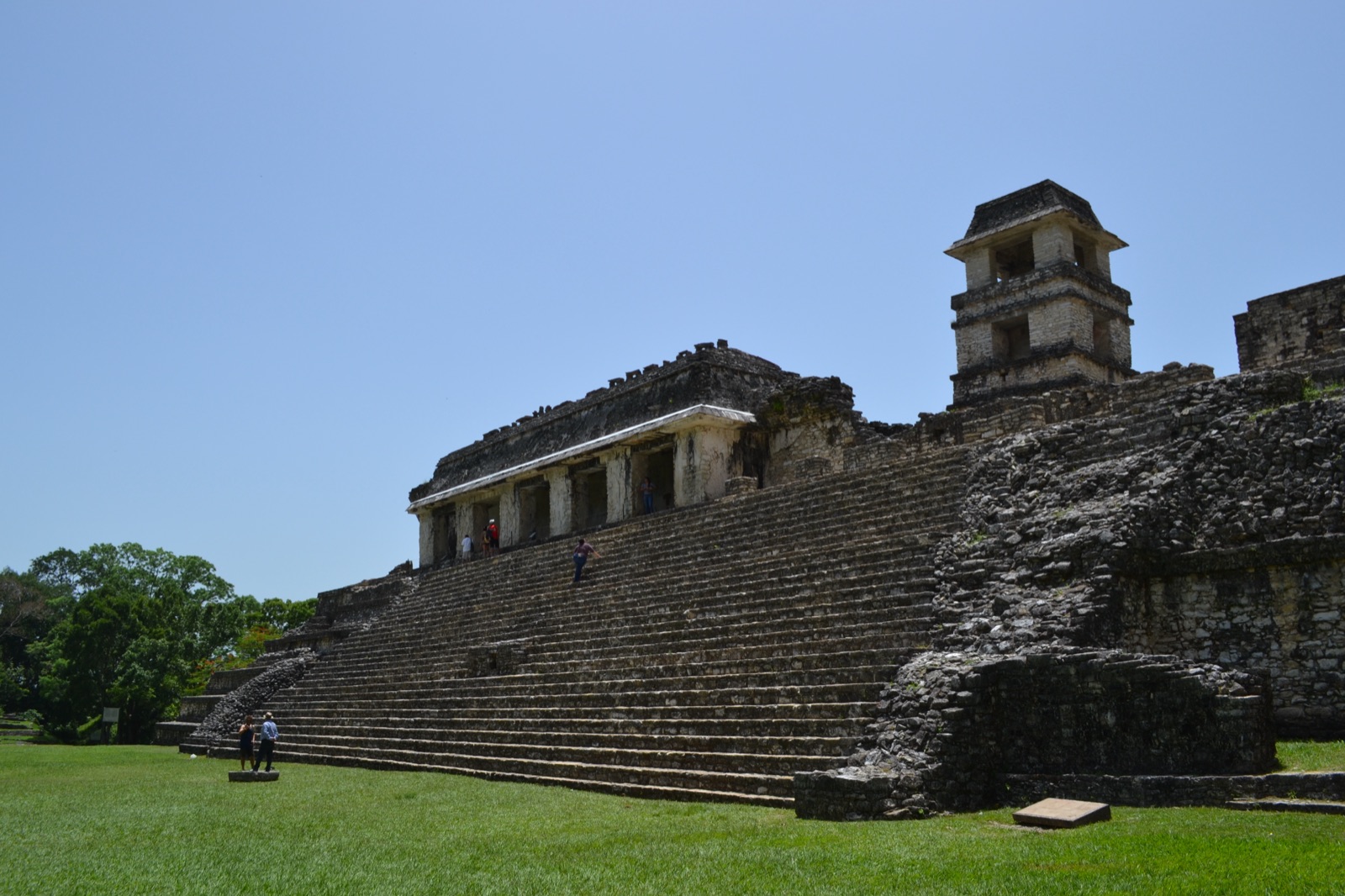
Its most distinctive feature is the four-story tower (Torre) — an unusually tall freestanding structure for Maya architecture, thought to have served as an astronomical observatory or watchtower. There's a story that on the winter solstice, looking through a specific window in the tower, the sun is designed to set in the direction of the Temple of the Inscriptions.

The doorways and windows of the Palace also show the T-shaped openings distinctive to Maya architecture. They've been read both as a practical solution for ventilating rain and wind and as carrying meaning as a sacred sign.
Cross Group (Grupo de las Cruces) — the Temples of the Cross and the Sun
Further east of the Palace, across a small stream and up onto higher ground, you reach the Cross Group (Grupo de las Cruces). Three temples — the Temple of the Cross (Templo de la Cruz), the Temple of the Sun (Templo del Sol), and the Temple of the Foliated Cross (Templo de la Cruz Foliada) — arranged in a U, said to be the architectural staging of the accession ritual of Pakal's son K'inich Kan B'alam II (Chan B'alam).
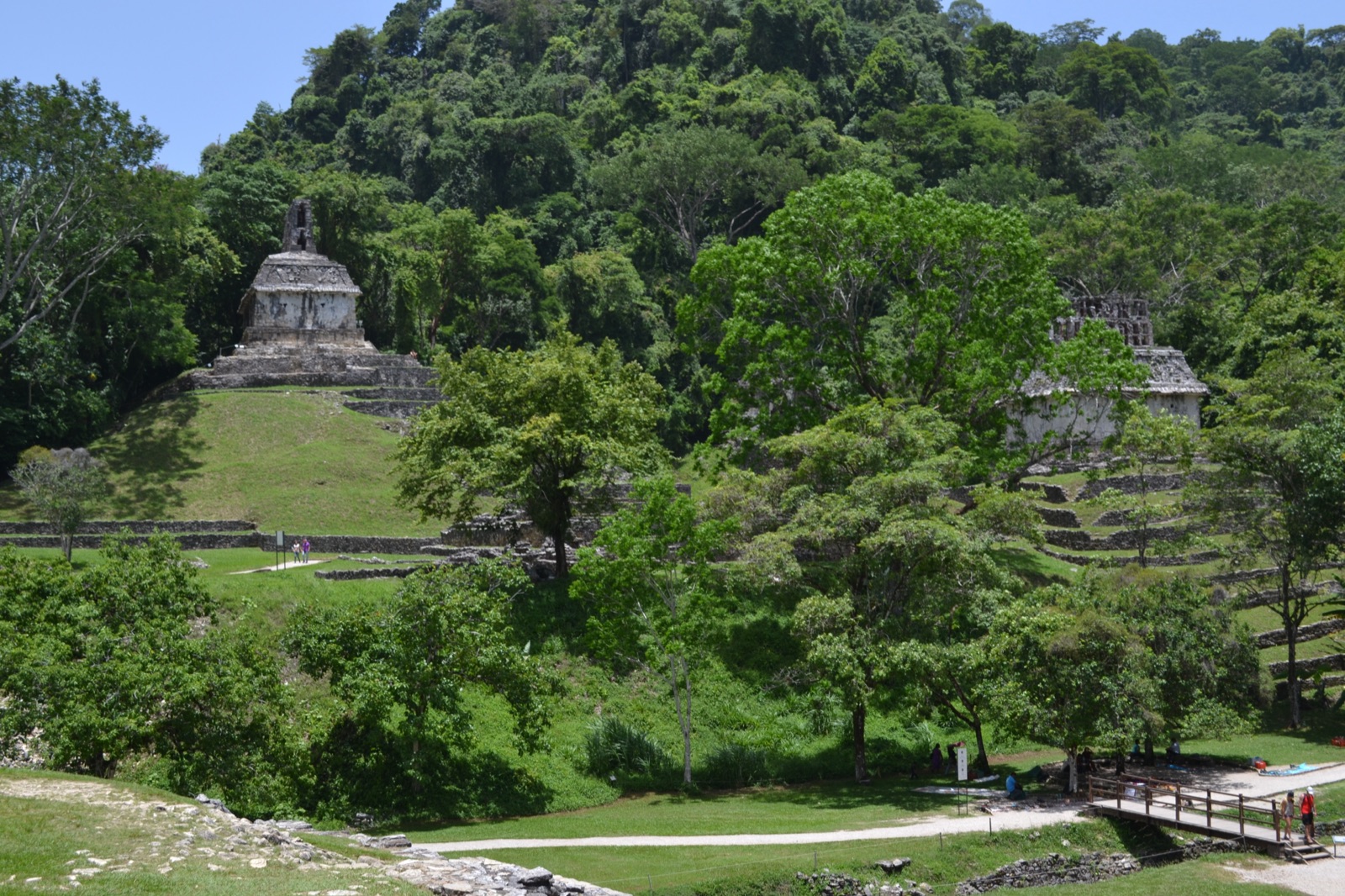
What all three share is the roof comb (peine de techo) on top of the summit temple — a thin lattice-like wall that rises above the building itself, decorated with sculpture and stucco. It lets air through while making the building look symbolically taller, and it's a signature detail of Palenque's architecture.

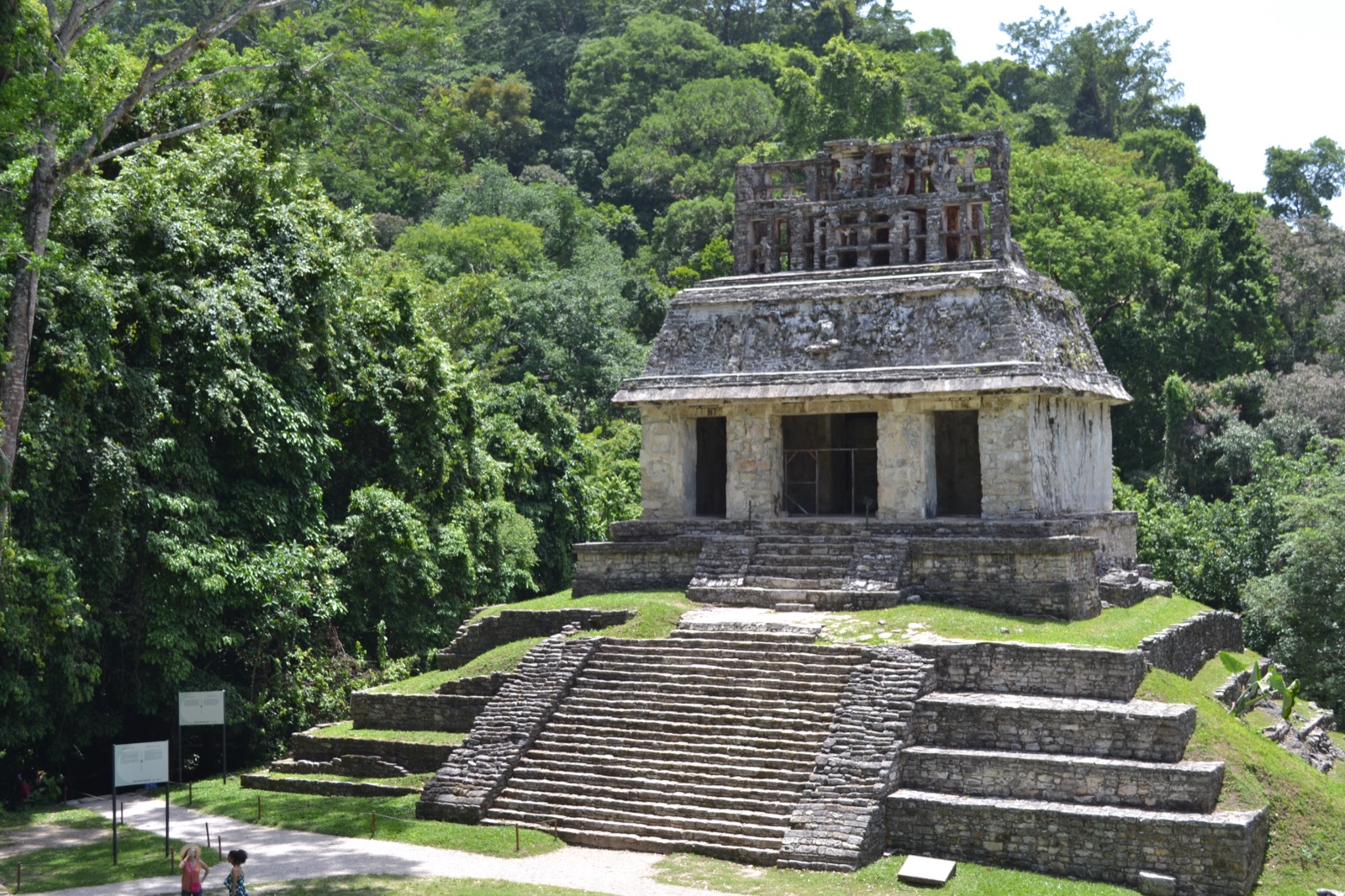
Inside the inner sanctuary of each temple is a symbolic stone panel centered on the World Tree, the Sun God, and the Maize God respectively (most originals have been moved to museums). Read together, they tell the story of how Kan B'alam inherited the lineage of the gods and gained kingship. The Cross Group was dedicated in AD 692, and the cross-shaped relief in the Temple of the Cross is in fact the Wakah-Chan, the Maya World Tree at the center of Maya cosmology — unrelated to the later Christian cross.
Why Palenque was abandoned — the Classic Maya collapse
Palenque was on the historical stage for only about 150 years, in the 7th and 8th centuries. By the 9th century it had shrunk rapidly, and by the 10th century it was essentially abandoned. This is part of the phenomenon known as the "Classic Maya collapse," during which Tikal, Calakmul, Copán and other major lowland Maya cities were abandoned in succession during the same period.
The cause was not single. Recent research suggests that prolonged drought, deforestation tied to agricultural expansion, population pressure, and intensifying warfare between city-states all contributed (see: Science — paleoclimate research on the Maya collapse (Kennett et al., 2012)). At Palenque, the last reliable dynastic inscription dates to AD 799; over the few generations after that, the city's institutions faded.
Becoming one with the jungle
The biggest draw of Palenque might not even be the buildings, but the feeling of "the jungle is in the middle of swallowing the ruins, and the motion happens to be paused right now." Unlike Teotihuacán's dry stone, the stone at Palenque is constantly damp, tinted faintly green with moss and lichen. The birds and insects don't stop, and behind the temple in front of you, more unexcavated hills stretch on, hidden in forest.
In fact, what's been cleared and opened to the public as the Palenque archaeological zone is only a small fraction of the city. Several times the number of recorded structures are still thought to be sleeping under the jungle. Even on the developed paths, mossy stones poke out by the edge here and there.
Coming here after experiencing Aztec and Teotihuacán culture as a "stack of civilization," Palenque shows you something different: the speed at which civilization is forgotten.
It's something more fragile and more humid than the 3,000-year-old Olmec heads or the Aztec Sun Stone, and it stays standing only because of the conservation work that keeps it alive.
Places I visited
Travel notes (general info)
※This section is editorial reference based on public information. Please confirm prices and operating details on official sites.
Getting there
- By air: domestic flight from Mexico City to Villahermosa (VSA), about 1h20 (VivaAerobus, Volaris). Then ADO bus from Villahermosa to Palenque town, about 2 hours
- Overland: direct ADO buses from Villahermosa or San Cristóbal de las Casas (overnight services available)
- Town to ruins: colectivo (shared taxi) from Palenque town to the site entrance, about 15 minutes. Taxi charter also possible
- Lodging: hotels in central Palenque town, or jungle cabañas near the ruins (El Panchan area)
Recommended nearby spots
- Misol-Ha Falls (Cascada Misol-Ha) — 35 m waterfall, about 1 hour by car from Palenque
- Agua Azul Cascades (Agua Azul) — turquoise stepped falls, about 2 hours by car
- Yaxchilán archaeological zone — Maya site on the Usumacinta River, accessed by boat. Day tours from Palenque are standard
- Bonampak archaeological zone — famous for vivid Classic Maya murals; usually combined with Yaxchilán
- Site Museum (Museo de Sitio) — at the ruins entrance, on-site display of finds
References
- UNESCO World Heritage Centre — Pre-Hispanic City and National Park of Palenque
- INAH (Mexico's National Institute of Anthropology and History) — Zona Arqueológica de Palenque
- Mesoweb — Palenque Resources (academic dynastic and epigraphic research)
- Wikipedia — Alberto Ruz Lhuillier
- Encyclopædia Britannica — Mesoamerican civilization
- Science (2012) — Development and Disintegration of Maya Political Systems in Response to Climate Change
- Mary Ellen Miller, Maya Art and Architecture (Thames & Hudson, 2nd ed., 2014) — definitive overview of Classic Maya architecture, including Palenque
- Michael D. Coe & Stephen Houston, The Maya (Thames & Hudson, 10th ed.) — the standard, readable introduction to ancient Maya archaeology, art and religion