"With a brace and a cane, she could absolutely walk indoors on her own. But there's no brace…"
It was 30 January 2014. I was sitting in the small clinic in San Vito, talking to myself in front of a chart, four months into my JICA Volunteer assignment in Costa Rica.
Discharged without a brace
The patient that day was three months out from a stroke. Brunnstrom stage Ⅱ-Ⅰ-Ⅲ, severely impaired sensation, ambulation with moderate assistance, sitting balance independent. In Japan, with the right short-leg brace and a cane, indoor walking on her own would have been a realistic goal at this stage.
But Costa Rica's public health system tops out at about a month of acute hospitalization for stroke. After that, patients are discharged — typically without a brace — and come home knowing only how to make it to the toilet with help and how to do a few self-exercises.
You can buy a cane in town. The brace was the problem. "Then I'll have to make one myself." That's where it started.
Walking the town for parts
The reference design was Iwata Haruyuki's simple short-leg brace. In Japan, the materials run about 2,000 yen at any hardware store. Translating that into materials available in a Costa Rican town turned out to be harder than I'd assumed. Hardware shops, the medical-supply room behind the pharmacy, the closest thing to a home-improvement store — none stocked strut-grade material. I ended up drawing the specs and ordering struts from a workshop in another town. Cost: about 8,000 yen out of pocket. On a Volunteer's stipend, where most of it disappears into rent and groceries, that was a meaningful hit.
What kept me going was simple: without a brace, this patient's gait doesn't start.
Finished
On 11 February 2014, the metal-strut simple short-leg brace was finished. With it strapped on, the patient walked a few steps, then looked up with a puzzled face and said, "It doesn't hurt." The months of trial and error felt a little lighter to carry.
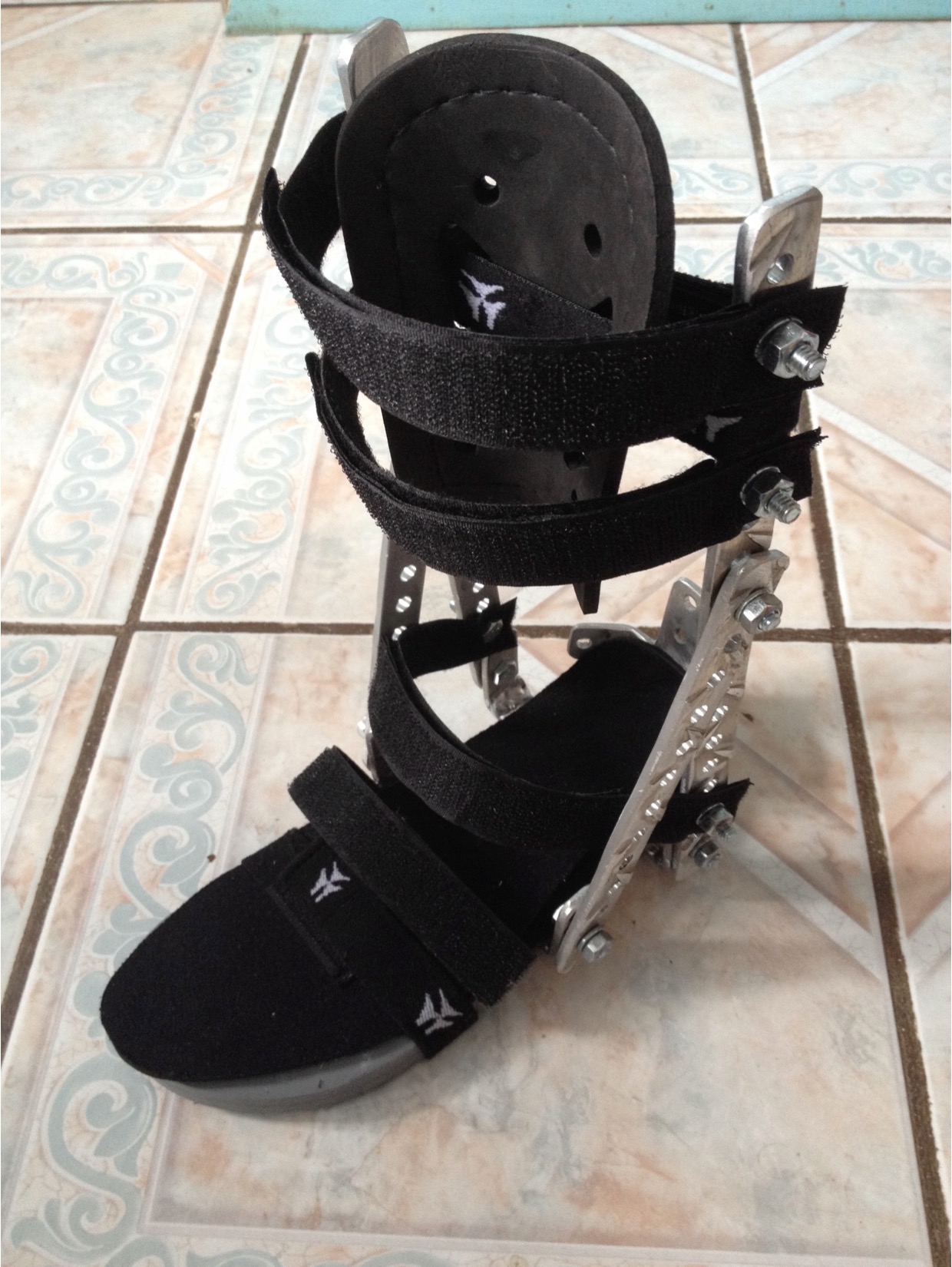
📐 The technical breakdown — parts list (metal struts, cut-down sandal sole, baseball elbow protector), material cost, and barefoot vs. braced gait comparison — is collected in the companion piece #9 "How I Built a Simple Short-Leg Brace in Costa Rica".
Donated braces and the SHB-only reality
About six months later, in July 2014, the Japanese initiative "Bringing Rehab Equipment to Developing Countries" reached the clinic with two donations: a plastic short-leg brace with bilateral metal uprights, and a short-leg brace with a Tamarack ankle joint. Braces sleeping in storage sheds at Japanese hospitals had found their way to a Costa Rican patient.
Showing the donations to colleagues drove home something I'd been sensing for months. The short-leg brace publicly prescribed after stroke in Costa Rica is essentially the SHB (a one-piece plastic shoehorn brace), as a default. Articulated braces with ankle joints were almost never something I saw in the field. It wasn't that the variety was "unknown" — structurally, the alternative often didn't exist as an option. The SHB is simple to fabricate and inexpensive, which is rational under tight medical budgets. But there are patients for whom an articulated brace would clearly be a better fit. How do you close that gap?
I had jotted down a question in my notebook back then:
When so many patients have no brace at all, is it wrong to push for higher-quality braces?
System, budget, training pipeline, on-the-ground priorities — all entangled. Ten years on, I still don't have a clean answer.
The 8-month wait
In parallel, my patient's official public brace was working its way through the system: consult → application → CENARE fabrication. The wait was eight months.
On 12 September 2014 it finally arrived. Made at the country's flagship rehab center. I had been hoping for something. What landed in my hands was, honestly, "more modest than I'd been expecting." The structure was close to an SHB, no ankle joint, with the marks of handwork still on it — a plain, simple brace.
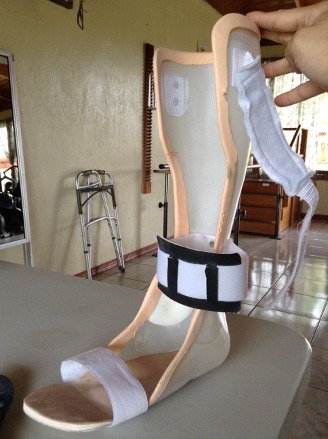
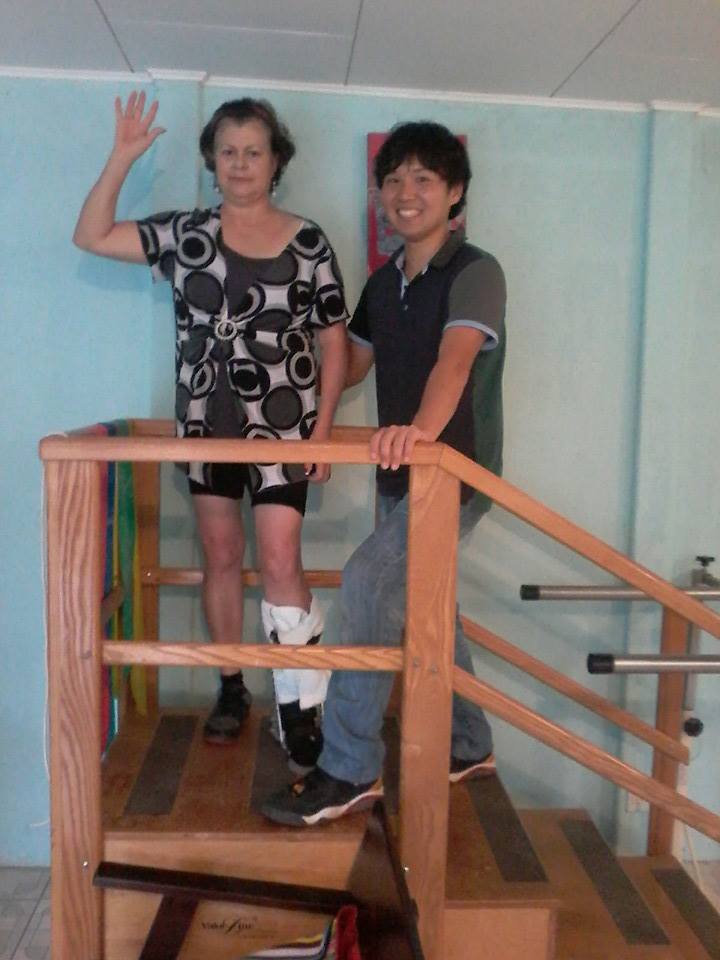
Even so, in a country where many patients don't even know a free public brace exists, walking with one stroke patient from first interview to brace delivery was a real win. She later spoke at a local women's group about her own life, and I asked her to weave in a few words about rehab and the brace system. On stage that day, she stood on her own two feet — wearing the brace.
What you can do without a brace
February 2015. Another patient came in. Right hemiplegia, BRS Ⅱ-Ⅰ-Ⅱ, motor aphasia. In Japan, the textbook plan would be a long-leg brace tapering down to a short-leg brace, aiming at independent walking.
For this patient, getting an official public brace simply wasn't going to happen — age, social situation, paperwork barriers. In Costa Rica, every box has to line up before you ride the system. We had to start from "no brace."
JICA helped fund a knee brace, and I supported the ankle joint with elastic bandages, and we started gait training. Bandage technique I'd practiced as a student paid off in a way I never expected. It wasn't an adequate setup, but as a stand-in for the brace that didn't exist, it worked.
One brace can change the entire landscape of a patient's gait. I had known that since my Japanese hospital days. What Costa Rica taught me was the second half: where the brace is missing, every other piece of knowledge, technique, and human relationship around the brace gets pulled in to fill the gap.
What I'm still asking
The questions I came home with are the ones I still work on:
- Within a tight medical budget, how far should brace variety reasonably extend?
- How do you address the geographic concentration of orthotist talent and the training gap?
- When patients and families don't even know the brace exists, who reaches them with information — and with the upstream paperwork, diagnoses, and transport that gate access to the system in the first place?
These line up almost exactly with what I'd later study in graduate school and work on as a researcher in assistive devices and disability policy. At the time I couldn't articulate it. But sitting in a small clinic in San Vito, drawing a strut design and walking the town for parts, I think the outline was being drawn.
My colleague and "Casa de Rehabilitación"
About one year into my posting, a Costa Rican physical therapist joined the clinic. The diagnoses and brace conversations I'd been carrying alone now had someone to share them with. "How do we leave behind something that keeps going after I'm gone?" — her presence was an enormous part of the answer.
The clinic's official sign read "Casa Atención a la Persona con Discapacidad" (Care House for People with Disabilities), but I had been calling it "Casa de Rehabilitación" (Rehabilitation House) day to day. Without anyone deciding it, the colleague and the patients started using the same name. Maybe the place's real name is decided by what actually happens there, not by the sign on the wall — for me, that shift quietly happened somewhere in the days of building braces.
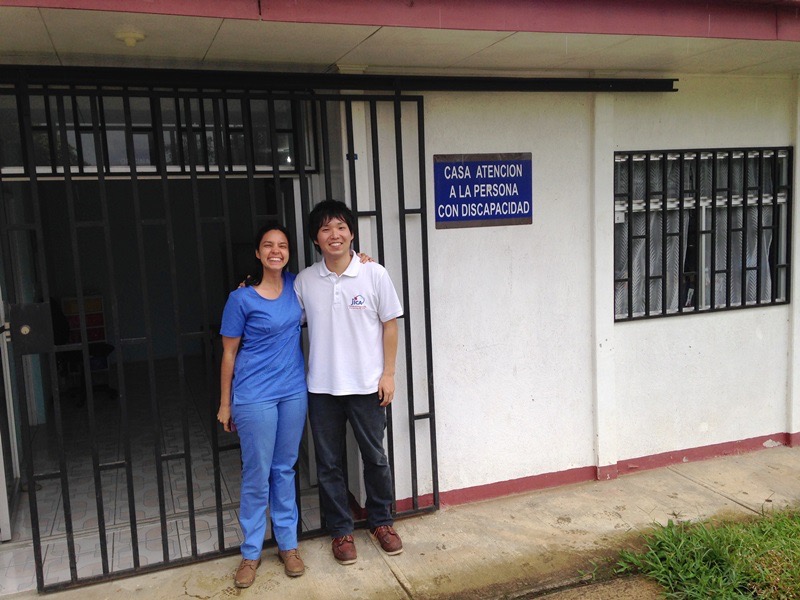
In August 2015, an elderly couple came in from the next town over. The husband was nine months post-stroke, the wife exhausted past her own limits. With enough rehab time, the right brace, and a cane, he might walk again. But brace fabrication needed six months minimum, free rehab was practically nonexistent, and my own posting was almost over. Referrals kept arriving with thin promises like "there's a great PT over there, you'll be fine." I left them with paperwork: a new wheelchair request, a brace application, a referral for rehab in the capital, caregiver coaching for the wife, a home practice plan. The next time they reached care would be in a year, or two.
My note from that day still reads: everything is too late. That sentence, scrawled across a chart, is where my research starts.
More than ten years have passed. I work in Japan now, on assistive-device and disability-policy research. Sitting at my desk with data in front of me, sometimes the afternoons of walking the town for parts, the patient's quiet "it doesn't hurt" the first time she stood in the brace, the conversations with my colleague at the clinic — all of it rises up, vivid, unannounced.
Those "Casa de Rehabilitación" days are still, quietly, holding up the questions I'm asking now.
Background information
Compiled by the editor from public sources. For current rules, please consult official references.
Common short-leg brace (AFO) types
- SHB (Shoehorn Brace): a one-piece plastic brace, the simplest design — light, cheap, almost no ankle motion
- Tamarack-articulated: a plastic AFO with a Tamarack ankle joint allowing dorsiflexion, supporting more natural gait
- Metal-upright: bilateral or unilateral metal struts paired with an ankle joint — heavier but easier to adjust
- Simple short-leg brace: a low-cost design built from common parts. Clinically valuable as a "bridge" in resource-limited settings
Costa Rica's rehab and brace system
- Public health system: run by CCSS (Caja Costarricense de Seguro Social). Acute stroke hospitalization is roughly one month
- Brace fabrication: centered at CENARE (Centro Nacional de Rehabilitación) in San José. Months to half a year-plus from referral to delivery is common
- Geographic concentration: orthotist and rehab specialty staff cluster in the capital; rural options are limited
- Family caregivers: post-discharge rehab leans heavily on family. Self-practice instruction and positioning guidance are central to clinic visits
Why simple, low-cost braces matter
- While the patient waits months for an official brace, a simple bridge brace keeps gait training from stalling — clinically meaningful
- WHO's Priority Assistive Products List (2016) emphasizes context-appropriate assistive product supply
- WHO estimates that, in low- and middle-income countries, only 5–15% of those who need assistive products actually have access to them
References
- WHO — Priority Assistive Products List
- CCSS — Caja Costarricense de Seguro Social
- Ministerio de Salud de Costa Rica
- JICA Volunteers
※ Brace selection and adjustment must be done under qualified medical supervision. This article is a personal record and is not a recommendation of any specific treatment or device.
Want to read more on orthotics
For SHB, articulated AFO, and metal-upright designs in their clinical context, the Japanese standard reference (jointly authored by the Japanese Orthopaedic Association and the Japanese Association of Rehabilitation Medicine) is the book I keep coming back to.